
Conditional probability helps us calculate how likely something is to... Mostrar más
 Mathematics
 Irish
Irish English
 Geography
Inscríbete para ver los apuntes¡Es gratis!
Acceso a todos los documentos
Mejora tus notas
Únete a millones de estudiantes
Knowunity AI
Asignaturas
Triangle Congruence and Similarity Theorems
Triangle Properties and Classification
Linear Equations and Graphs
Geometric Angle Relationships
Trigonometric Functions and Identities
Equation Solving Techniques
Circle Geometry Fundamentals
Division Operations and Methods
Basic Differentiation Rules
Exponent and Logarithm Properties
Mostrar todos los temas
Human Organ Systems
Reproductive Cell Cycles
Biological Sciences Subdisciplines
Cellular Energy Metabolism
Autotrophic Energy Processes
Inheritance Patterns and Principles
Biomolecular Structure and Organization
Cell Cycle and Division Mechanics
Cellular Organization and Development
Biological Structural Organization
Mostrar todos los temas
Chemical Sciences and Applications
Atomic Structure and Composition
Molecular Electron Structure Representation
Atomic Electron Behavior
Matter Properties and Water
Mole Concept and Calculations
Gas Laws and Behavior
Periodic Table Organization
Chemical Thermodynamics Fundamentals
Chemical Bond Types and Properties
Mostrar todos los temas
European Renaissance and Enlightenment
European Cultural Movements 800-1920
American Revolution Era 1763-1797
American Civil War 1861-1865
Global Imperial Systems
Mongol and Chinese Dynasties
U.S. Presidents and World Leaders
Historical Sources and Documentation
World Wars Era and Impact
World Religious Systems
Mostrar todos los temas
Classic and Contemporary Novels
Literary Character Analysis
Rhetorical Theory and Practice
Classic Literary Narratives
Reading Analysis and Interpretation
Narrative Structure and Techniques
English Language Components
Influential English-Language Authors
Basic Sentence Structure
Narrative Voice and Perspective
Mostrar todos los temas
1
•
Actualizado May 5, 2026
•
Conditional probability helps us calculate how likely something is to... Mostrar más
Ever wondered how doctors calculate your chances of having a disease after a positive test? That's conditional probability in action! It's all about finding the probability of an event A occurring when we already know event B has happened, written as P(A|B).
When we learn new information, our "sample space" (the total possible outcomes) gets smaller, which changes the probabilities. Think of it like narrowing down your suspects in a detective game after getting a new clue.
Some key terms you'll need to know include conditional probability (the chance of A happening given B already happened), independent events (when one event doesn't affect another), and mutually exclusive events (when two events can't happen simultaneously).
Remember! Don't confuse independence with mutual exclusivity. They're completely different concepts, and mixing them up is one of the most common mistakes in probability questions.
The main formula for conditional probability is: P(A|B) = P(A∩B)/P(B)
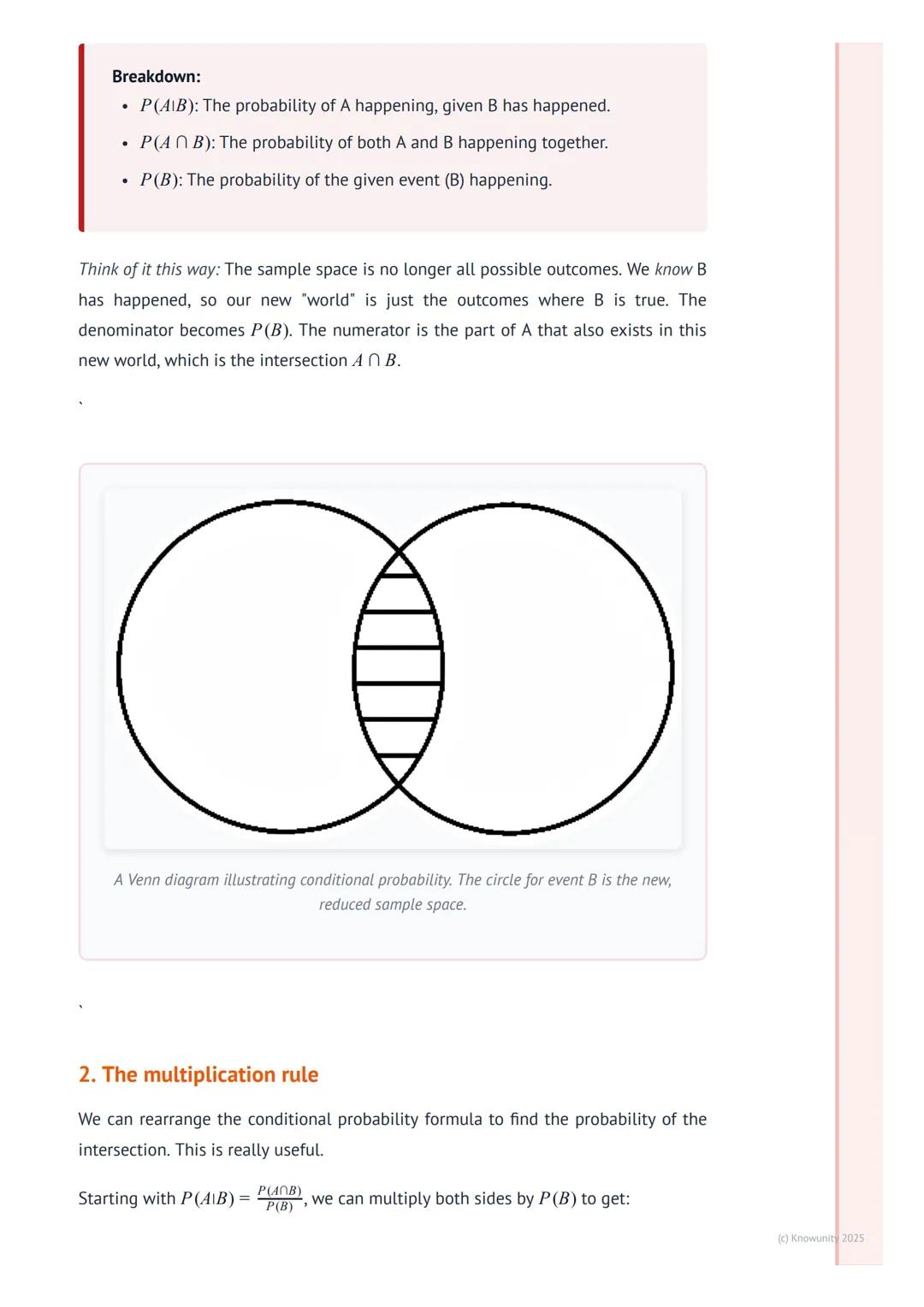
Let's decode that conditional probability formula properly. P(A|B) represents the probability of A happening, given B has already occurred. P(A∩B) is the probability of both events happening together (their intersection), and P(B) is simply the probability of event B.
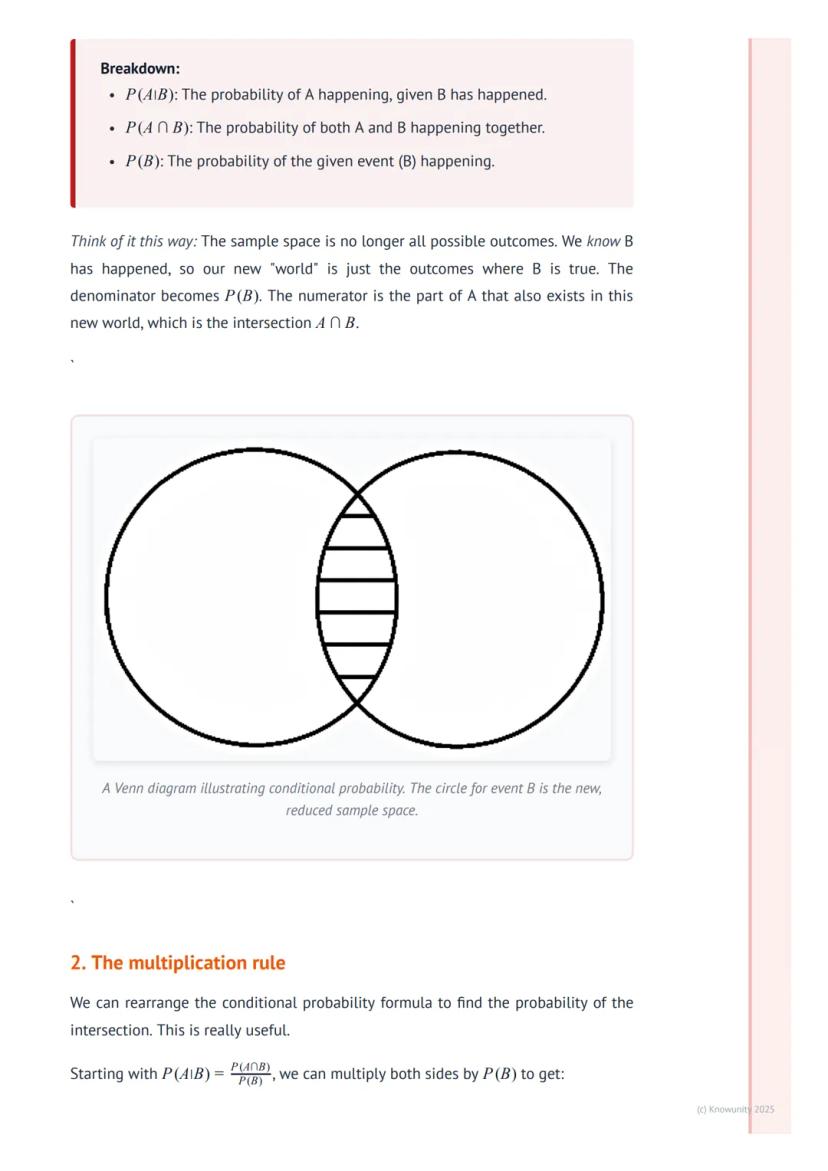
Think of it this way: once B has happened, our world shrinks to just the outcomes where B is true. Within this smaller world, we want to know what portion contains event A as well. The formula helps us calculate exactly that!
We can rearrange this formula to get the multiplication rule: P(A∩B) = P(A|B) × P(B). This is incredibly useful when calculating the probability of sequences of events, especially in more complex problems.
Pro tip: Drawing a Venn diagram can really help visualize conditional probability. Circle B becomes your new "universe" and you're looking at how much of A falls inside it.
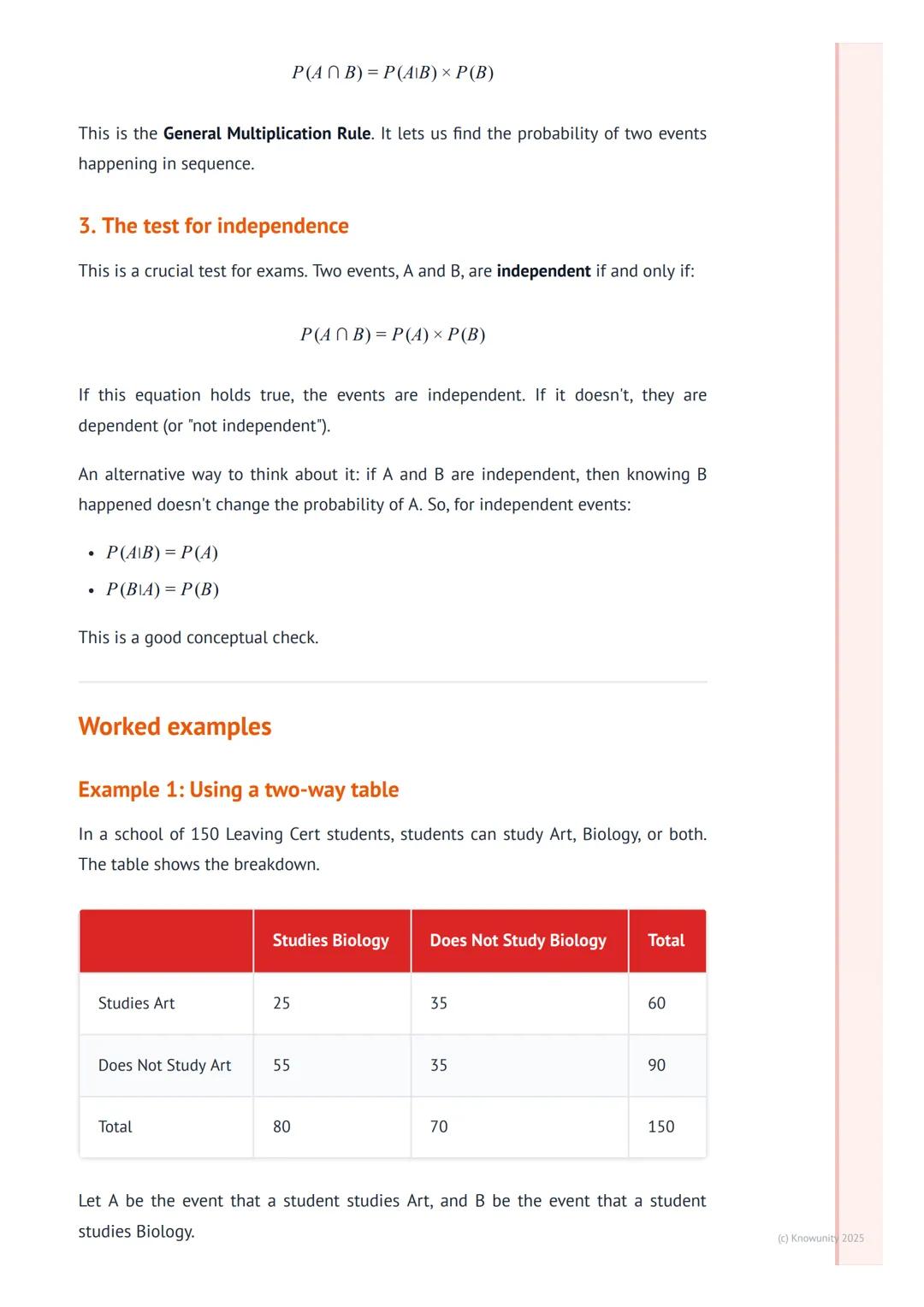
How do you know if events are truly independent? Two events A and B are independent if and only if: P(A∩B) = P(A) × P(B). This is your golden test for independence in the exam!
Another way to check independence is to see if P(A|B) = P(A). If knowing B happened doesn't change the probability of A happening, then they're independent. For example, rolling a die twice gives independent results - the first roll doesn't affect the second.
The multiplication rule for independent events makes calculations much simpler, but be careful! You must verify independence before applying this shortcut, or your answer could be wrong.
Exam Alert: Questions often ask you to determine whether events are independent. Always use the test P(A∩B) = P(A) × P(B) to check, rather than just assuming independence based on the scenario.
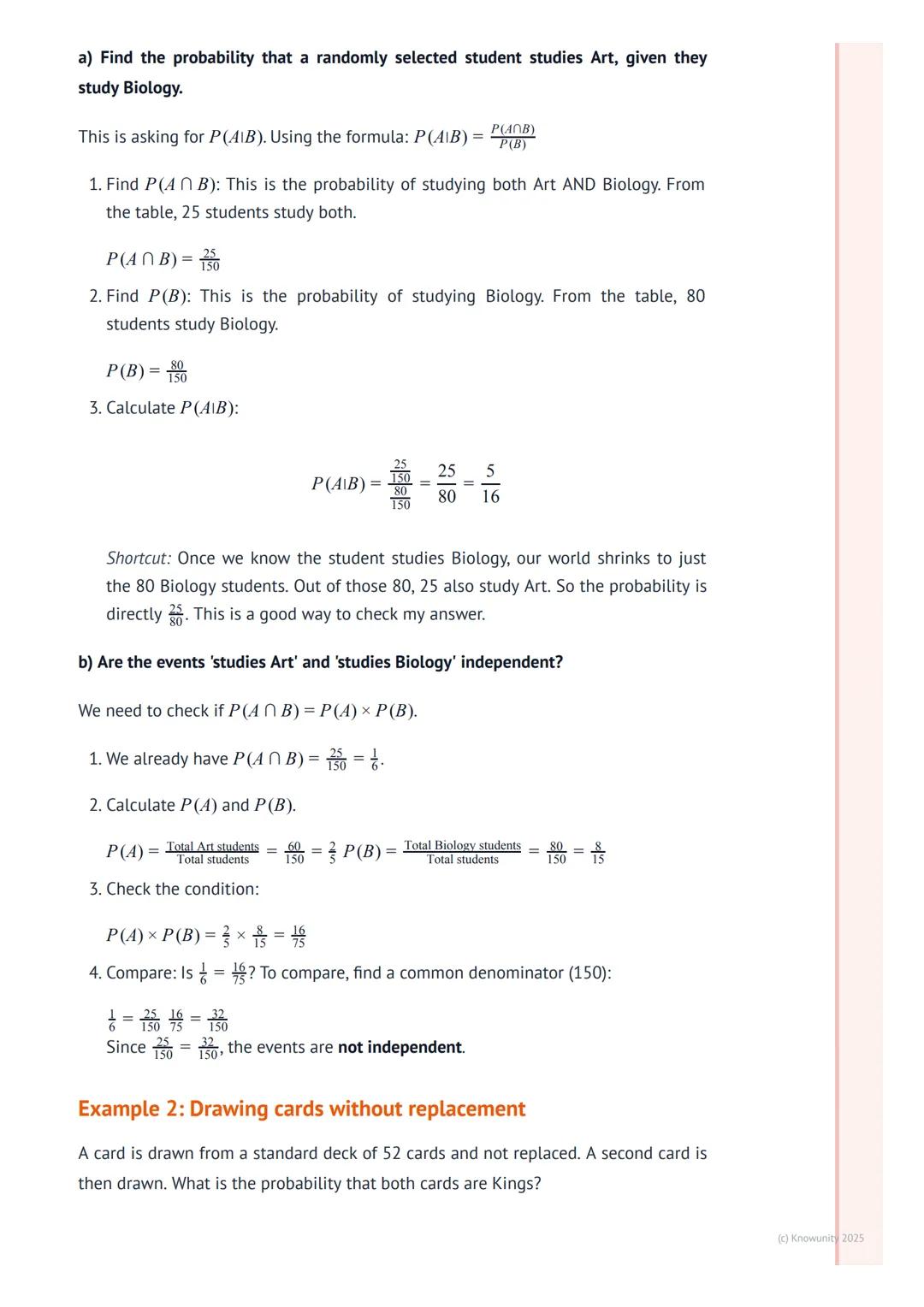
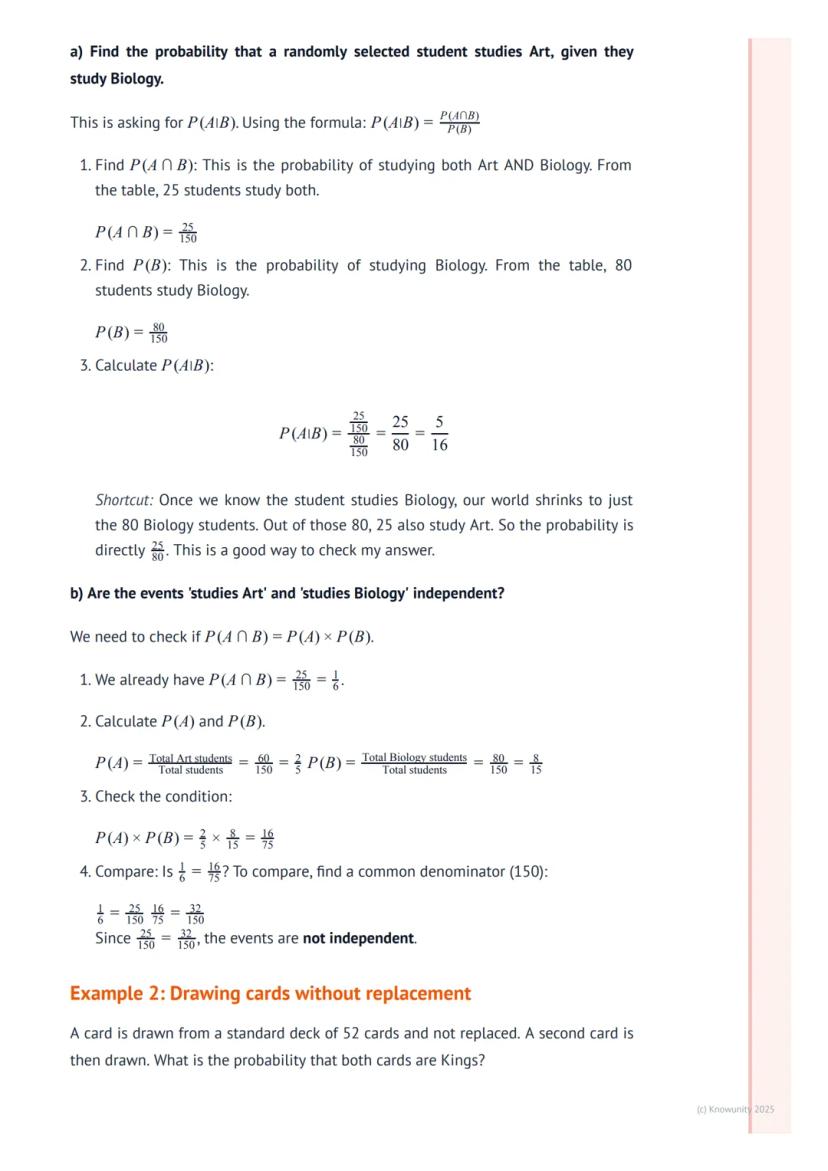
Two-way tables are goldmines for conditional probability questions! Let's look at a school example with Art and Biology students.
To find the probability a student studies Art given they study Biology—P(A|B)—we use our formula P(A|B) = P(A∩B)/P(B). From the table, 25 students study both subjects out of 150 total students, so P(A∩B) = 25/150. There are 80 Biology students, so P(B) = 80/150. Therefore, P(A|B) = (25/150)/(80/150) = 25/80 = 5/16.
A faster way to think about this: once we know the student studies Biology, we're only looking at those 80 students. Of those, 25 also study Art, so the probability is 25/80.
To test if studying Art and studying Biology are independent events, we check if P(A∩B) = P(A) × P(B). We calculate P(A) = 60/150 = 2/5 and P(B) = 80/150 = 8/15. Then P(A) × P(B) = (2/5) × (8/15) = 16/75. Since P(A∩B) = 25/150 ≠ 16/75, the events are not independent.
Quick trick: When working with tables, conditional probability is often just the cell count divided by the row or column total, depending on your "given" condition.
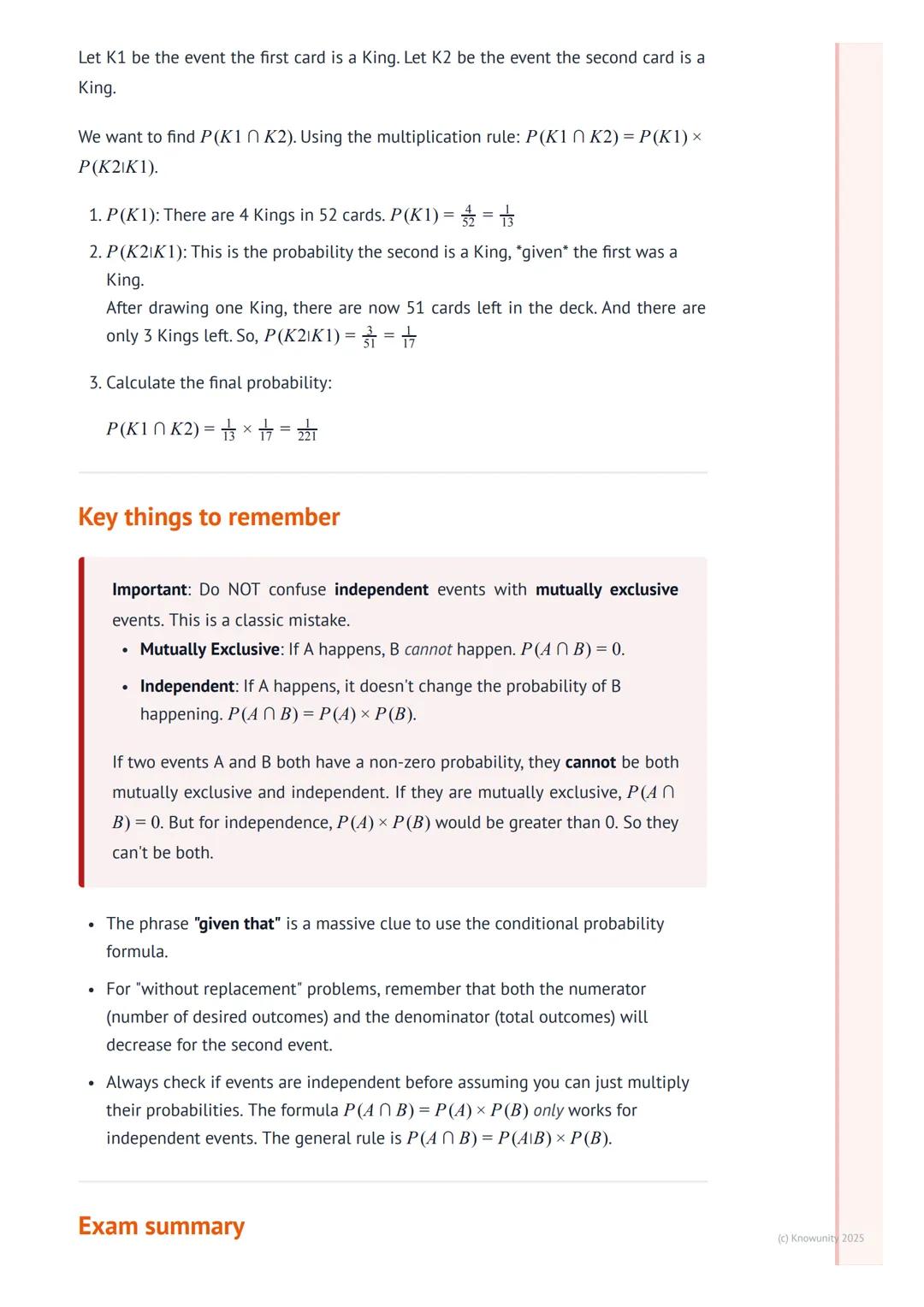
When drawing cards without replacement, the probabilities change with each draw because the sample space shrinks. This is a perfect application of conditional probability!
For example, finding the probability of drawing two Kings in a row requires the multiplication rule: P(K1∩K2) = P(K1) × P(K2|K1). The probability of drawing a King first is P(K1) = 4/52 = 1/13. After drawing one King, there are 3 Kings left in 51 cards, so P(K2|K1) = 3/51 = 1/17. Therefore, P(K1∩K2) = (1/13) × (1/17) = 1/221.
The key insight here is that the second event's probability depends on what happened in the first event—this is a dependent scenario because we're not replacing the cards.
Remember: In "without replacement" problems, both your numerator (desired outcomes) and denominator (total outcomes) decrease after each selection. This changes the probabilities!
Avoid the classic mistake of confusing mutually exclusive events with independent events. If A and B are mutually exclusive, P(A∩B) = 0. But for independence, P(A∩B) = P(A) × P(B). Since P(A) × P(B) > 0 , events cannot be both mutually exclusive and independent!
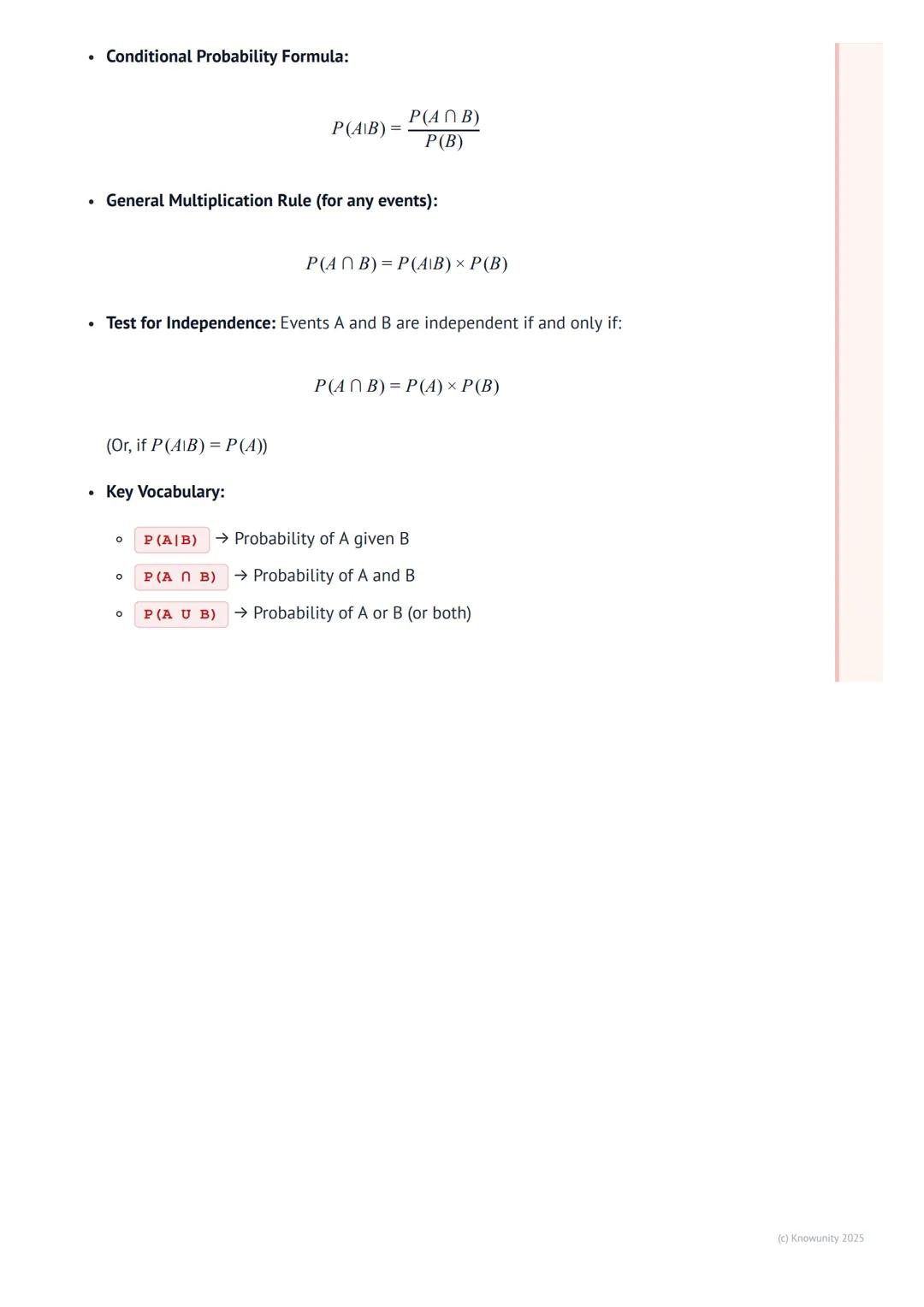
Master these three key formulas for your exam: the conditional probability formula P(A|B) = P(A∩B)/P(B), the general multiplication rule P(A∩B) = P(A|B) × P(B), and the test for independence P(A∩B) = P(A) × P(B).
Look for key phrases in exam questions that signal which formula to use. The words "given that" are a massive clue to use conditional probability. "Without replacement" indicates dependent events, while "with replacement" usually means independent events.
The notation is crucial too: P(A|B) means probability of A given B, P(A∩B) means probability of A and B both happening, and P(A∪B) means probability of either A or B (or both) happening.
Exam strategy: When faced with complex probability problems, draw a diagram! Whether it's a Venn diagram, a tree diagram, or a table, visual representations make conditional probability much clearer and help avoid mistakes.
With practice, you'll spot patterns in these problems and develop the confidence to tackle even the trickiest conditional probability questions in your Leaving Cert exam!
Nuestro compañero de IA está específicamente adaptado a las necesidades de los estudiantes. Basándonos en los millones de contenidos que tenemos en la plataforma, podemos dar a los estudiantes respuestas realmente significativas y relevantes. Pero no se trata solo de respuestas, el compañero también guía a los estudiantes a través de sus retos de aprendizaje diarios, con planes de aprendizaje personalizados, cuestionarios o contenidos en el chat y una personalización del 100% basada en las habilidades y el desarrollo de los estudiantes.
Puedes descargar la app en Google Play Store y Apple App Store.
¡Sí lo es! Tienes acceso totalmente gratuito a todo el contenido de la app, puedes chatear con otros alumnos y recibir ayuda inmeditamente. Puedes ganar dinero utilizando la aplicación, que te permitirá acceder a determinadas funciones.
App Store
Google Play
La app es muy fácil de usar y está muy bien diseñada. Hasta ahora he encontrado todo lo que estaba buscando y he podido aprender mucho de las presentaciones. Definitivamente utilizaré la aplicación para un examen de clase. Y, por supuesto, también me sirve mucho de inspiración.
Pablo
usuario de iOS
Esta app es realmente genial. Hay tantos apuntes de clase y ayuda [...]. Tengo problemas con matemáticas, por ejemplo, y la aplicación tiene muchas opciones de ayuda. Gracias a Knowunity, he mejorado en mates. Se la recomiendo a todo el mundo.
Elena
usuaria de Android
Vaya, estoy realmente sorprendida. Acabo de probar la app porque la he visto anunciada muchas veces y me he quedado absolutamente alucinada. Esta app es LA AYUDA que quieres para el insti y, sobre todo, ofrece muchísimas cosas, como ejercicios y hojas informativas, que a mí personalmente me han sido MUY útiles.
Ana
usuaria de iOS
Solía tener dificultades para completar mis tareas a tiempo hasta que descubrí Knowunity, que no solo facilita subir mi propio contenido sino que también proporciona excelentes resúmenes que hacen mi trabajo más rápido y eficiente.
Thomas R
usuario de iOS
Siempre era un desafío encontrar toda la información importante para mis tareas – desde que comencé a usar Knowunity, puedo simplemente subir mi contenido y beneficiarme de los resúmenes de otros, lo que me ayuda mucho con la organización.
Lisa M
usuario de Android
A menudo sentía que no tenía suficiente visión general al estudiar, pero desde que comencé a usar Knowunity, eso ya no es un problema – subo mi contenido y siempre encuentro resúmenes útiles en la plataforma, lo que hace mi aprendizaje mucho más fácil.
David K
usuario de iOS
¡La app es buenísima! Sólo tengo que introducir el tema en la barra de búsqueda y recibo la respuesta muy rápido. No tengo que ver 10 vídeos de YouTube para entender algo, así que me ahorro tiempo. ¡Muy recomendable!
Sara
usuaria de Android
En el instituto era muy malo en matemáticas, pero gracias a la app, ahora saco mejores notas. Os agradezco mucho que hayáis creado la aplicación.
Roberto
usuario de Android
Solía ser muy difícil reunir toda la información para mis presentaciones. Pero desde que comencé a usar Knowunity, solo subo mis notas y encuentro increíbles resúmenes de otros – ¡hace mi estudio mucho más eficiente!
Julia S
usuario de Android
Siempre estaba estresado con todo el material de estudio, pero desde que comencé a usar Knowunity, subo mis cosas y reviso los geniales resúmenes de otros – realmente me ayuda a manejar todo mejor y es mucho menos estresante.
Marco B
usuario de iOS
LOS QUIZZES Y FLASHCARDS SON SÚPER ÚTILES Y AMO Knowunity AI. TAMBIÉN ES LITERALMENTE COMO CHATGPT PERO MÁS INTELIGENTE!! ME AYUDÓ CON MIS PROBLEMAS DE RÍMEL TAMBIÉN!! Y CON MIS MATERIAS REALES OBVIO! 😍😁😲🤑💗✨🎀😮
Sarah L
usuario de Android
Antes pasaba horas buscando en Google materiales escolares, pero ahora solo subo mis cosas a Knowunity y reviso los útiles resúmenes de otros – me siento mucho más seguro cuando me preparo para los exámenes.
Paul T
usuario de iOS
La app es muy fácil de usar y está muy bien diseñada. Hasta ahora he encontrado todo lo que estaba buscando y he podido aprender mucho de las presentaciones. Definitivamente utilizaré la aplicación para un examen de clase. Y, por supuesto, también me sirve mucho de inspiración.
Pablo
usuario de iOS
Esta app es realmente genial. Hay tantos apuntes de clase y ayuda [...]. Tengo problemas con matemáticas, por ejemplo, y la aplicación tiene muchas opciones de ayuda. Gracias a Knowunity, he mejorado en mates. Se la recomiendo a todo el mundo.
Elena
usuaria de Android
Vaya, estoy realmente sorprendida. Acabo de probar la app porque la he visto anunciada muchas veces y me he quedado absolutamente alucinada. Esta app es LA AYUDA que quieres para el insti y, sobre todo, ofrece muchísimas cosas, como ejercicios y hojas informativas, que a mí personalmente me han sido MUY útiles.
Ana
usuaria de iOS
Solía tener dificultades para completar mis tareas a tiempo hasta que descubrí Knowunity, que no solo facilita subir mi propio contenido sino que también proporciona excelentes resúmenes que hacen mi trabajo más rápido y eficiente.
Thomas R
usuario de iOS
Siempre era un desafío encontrar toda la información importante para mis tareas – desde que comencé a usar Knowunity, puedo simplemente subir mi contenido y beneficiarme de los resúmenes de otros, lo que me ayuda mucho con la organización.
Lisa M
usuario de Android
A menudo sentía que no tenía suficiente visión general al estudiar, pero desde que comencé a usar Knowunity, eso ya no es un problema – subo mi contenido y siempre encuentro resúmenes útiles en la plataforma, lo que hace mi aprendizaje mucho más fácil.
David K
usuario de iOS
¡La app es buenísima! Sólo tengo que introducir el tema en la barra de búsqueda y recibo la respuesta muy rápido. No tengo que ver 10 vídeos de YouTube para entender algo, así que me ahorro tiempo. ¡Muy recomendable!
Sara
usuaria de Android
En el instituto era muy malo en matemáticas, pero gracias a la app, ahora saco mejores notas. Os agradezco mucho que hayáis creado la aplicación.
Roberto
usuario de Android
Solía ser muy difícil reunir toda la información para mis presentaciones. Pero desde que comencé a usar Knowunity, solo subo mis notas y encuentro increíbles resúmenes de otros – ¡hace mi estudio mucho más eficiente!
Julia S
usuario de Android
Siempre estaba estresado con todo el material de estudio, pero desde que comencé a usar Knowunity, subo mis cosas y reviso los geniales resúmenes de otros – realmente me ayuda a manejar todo mejor y es mucho menos estresante.
Marco B
usuario de iOS
LOS QUIZZES Y FLASHCARDS SON SÚPER ÚTILES Y AMO Knowunity AI. TAMBIÉN ES LITERALMENTE COMO CHATGPT PERO MÁS INTELIGENTE!! ME AYUDÓ CON MIS PROBLEMAS DE RÍMEL TAMBIÉN!! Y CON MIS MATERIAS REALES OBVIO! 😍😁😲🤑💗✨🎀😮
Sarah L
usuario de Android
Antes pasaba horas buscando en Google materiales escolares, pero ahora solo subo mis cosas a Knowunity y reviso los útiles resúmenes de otros – me siento mucho más seguro cuando me preparo para los exámenes.
Paul T
usuario de iOS
Conditional probability helps us calculate how likely something is to happen when we already know something else has happened. It's a powerful concept in statistics that's essential for the Leaving Cert, helping us understand how new information changes probabilities in... Mostrar más
Acceso a todos los documentos
Mejora tus notas
Únete a millones de estudiantes
Ever wondered how doctors calculate your chances of having a disease after a positive test? That's conditional probability in action! It's all about finding the probability of an event A occurring when we already know event B has happened, written as P(A|B).
When we learn new information, our "sample space" (the total possible outcomes) gets smaller, which changes the probabilities. Think of it like narrowing down your suspects in a detective game after getting a new clue.
Some key terms you'll need to know include conditional probability (the chance of A happening given B already happened), independent events (when one event doesn't affect another), and mutually exclusive events (when two events can't happen simultaneously).
Remember! Don't confuse independence with mutual exclusivity. They're completely different concepts, and mixing them up is one of the most common mistakes in probability questions.
The main formula for conditional probability is: P(A|B) = P(A∩B)/P(B)
Acceso a todos los documentos
Mejora tus notas
Únete a millones de estudiantes
Let's decode that conditional probability formula properly. P(A|B) represents the probability of A happening, given B has already occurred. P(A∩B) is the probability of both events happening together (their intersection), and P(B) is simply the probability of event B.
Think of it this way: once B has happened, our world shrinks to just the outcomes where B is true. Within this smaller world, we want to know what portion contains event A as well. The formula helps us calculate exactly that!
We can rearrange this formula to get the multiplication rule: P(A∩B) = P(A|B) × P(B). This is incredibly useful when calculating the probability of sequences of events, especially in more complex problems.
Pro tip: Drawing a Venn diagram can really help visualize conditional probability. Circle B becomes your new "universe" and you're looking at how much of A falls inside it.
Acceso a todos los documentos
Mejora tus notas
Únete a millones de estudiantes
How do you know if events are truly independent? Two events A and B are independent if and only if: P(A∩B) = P(A) × P(B). This is your golden test for independence in the exam!
Another way to check independence is to see if P(A|B) = P(A). If knowing B happened doesn't change the probability of A happening, then they're independent. For example, rolling a die twice gives independent results - the first roll doesn't affect the second.
The multiplication rule for independent events makes calculations much simpler, but be careful! You must verify independence before applying this shortcut, or your answer could be wrong.
Exam Alert: Questions often ask you to determine whether events are independent. Always use the test P(A∩B) = P(A) × P(B) to check, rather than just assuming independence based on the scenario.
Acceso a todos los documentos
Mejora tus notas
Únete a millones de estudiantes
Two-way tables are goldmines for conditional probability questions! Let's look at a school example with Art and Biology students.
To find the probability a student studies Art given they study Biology—P(A|B)—we use our formula P(A|B) = P(A∩B)/P(B). From the table, 25 students study both subjects out of 150 total students, so P(A∩B) = 25/150. There are 80 Biology students, so P(B) = 80/150. Therefore, P(A|B) = (25/150)/(80/150) = 25/80 = 5/16.
A faster way to think about this: once we know the student studies Biology, we're only looking at those 80 students. Of those, 25 also study Art, so the probability is 25/80.
To test if studying Art and studying Biology are independent events, we check if P(A∩B) = P(A) × P(B). We calculate P(A) = 60/150 = 2/5 and P(B) = 80/150 = 8/15. Then P(A) × P(B) = (2/5) × (8/15) = 16/75. Since P(A∩B) = 25/150 ≠ 16/75, the events are not independent.
Quick trick: When working with tables, conditional probability is often just the cell count divided by the row or column total, depending on your "given" condition.
Acceso a todos los documentos
Mejora tus notas
Únete a millones de estudiantes
When drawing cards without replacement, the probabilities change with each draw because the sample space shrinks. This is a perfect application of conditional probability!
For example, finding the probability of drawing two Kings in a row requires the multiplication rule: P(K1∩K2) = P(K1) × P(K2|K1). The probability of drawing a King first is P(K1) = 4/52 = 1/13. After drawing one King, there are 3 Kings left in 51 cards, so P(K2|K1) = 3/51 = 1/17. Therefore, P(K1∩K2) = (1/13) × (1/17) = 1/221.
The key insight here is that the second event's probability depends on what happened in the first event—this is a dependent scenario because we're not replacing the cards.
Remember: In "without replacement" problems, both your numerator (desired outcomes) and denominator (total outcomes) decrease after each selection. This changes the probabilities!
Avoid the classic mistake of confusing mutually exclusive events with independent events. If A and B are mutually exclusive, P(A∩B) = 0. But for independence, P(A∩B) = P(A) × P(B). Since P(A) × P(B) > 0 , events cannot be both mutually exclusive and independent!
Acceso a todos los documentos
Mejora tus notas
Únete a millones de estudiantes
Master these three key formulas for your exam: the conditional probability formula P(A|B) = P(A∩B)/P(B), the general multiplication rule P(A∩B) = P(A|B) × P(B), and the test for independence P(A∩B) = P(A) × P(B).
Look for key phrases in exam questions that signal which formula to use. The words "given that" are a massive clue to use conditional probability. "Without replacement" indicates dependent events, while "with replacement" usually means independent events.
The notation is crucial too: P(A|B) means probability of A given B, P(A∩B) means probability of A and B both happening, and P(A∪B) means probability of either A or B (or both) happening.
Exam strategy: When faced with complex probability problems, draw a diagram! Whether it's a Venn diagram, a tree diagram, or a table, visual representations make conditional probability much clearer and help avoid mistakes.
With practice, you'll spot patterns in these problems and develop the confidence to tackle even the trickiest conditional probability questions in your Leaving Cert exam!
Nuestro compañero de IA está específicamente adaptado a las necesidades de los estudiantes. Basándonos en los millones de contenidos que tenemos en la plataforma, podemos dar a los estudiantes respuestas realmente significativas y relevantes. Pero no se trata solo de respuestas, el compañero también guía a los estudiantes a través de sus retos de aprendizaje diarios, con planes de aprendizaje personalizados, cuestionarios o contenidos en el chat y una personalización del 100% basada en las habilidades y el desarrollo de los estudiantes.
Puedes descargar la app en Google Play Store y Apple App Store.
¡Sí lo es! Tienes acceso totalmente gratuito a todo el contenido de la app, puedes chatear con otros alumnos y recibir ayuda inmeditamente. Puedes ganar dinero utilizando la aplicación, que te permitirá acceder a determinadas funciones.
0
Herramientas Inteligentes NUEVO
Convierte estos apuntes en: ✓ 50+ Preguntas de Práctica ✓ Tarjetas de Estudio Interactivas ✓ Examen Completo de Práctica ✓ Esquemas de Ensayo
App Store
Google Play
La app es muy fácil de usar y está muy bien diseñada. Hasta ahora he encontrado todo lo que estaba buscando y he podido aprender mucho de las presentaciones. Definitivamente utilizaré la aplicación para un examen de clase. Y, por supuesto, también me sirve mucho de inspiración.
Pablo
usuario de iOS
Esta app es realmente genial. Hay tantos apuntes de clase y ayuda [...]. Tengo problemas con matemáticas, por ejemplo, y la aplicación tiene muchas opciones de ayuda. Gracias a Knowunity, he mejorado en mates. Se la recomiendo a todo el mundo.
Elena
usuaria de Android
Vaya, estoy realmente sorprendida. Acabo de probar la app porque la he visto anunciada muchas veces y me he quedado absolutamente alucinada. Esta app es LA AYUDA que quieres para el insti y, sobre todo, ofrece muchísimas cosas, como ejercicios y hojas informativas, que a mí personalmente me han sido MUY útiles.
Ana
usuaria de iOS
Solía tener dificultades para completar mis tareas a tiempo hasta que descubrí Knowunity, que no solo facilita subir mi propio contenido sino que también proporciona excelentes resúmenes que hacen mi trabajo más rápido y eficiente.
Thomas R
usuario de iOS
Siempre era un desafío encontrar toda la información importante para mis tareas – desde que comencé a usar Knowunity, puedo simplemente subir mi contenido y beneficiarme de los resúmenes de otros, lo que me ayuda mucho con la organización.
Lisa M
usuario de Android
A menudo sentía que no tenía suficiente visión general al estudiar, pero desde que comencé a usar Knowunity, eso ya no es un problema – subo mi contenido y siempre encuentro resúmenes útiles en la plataforma, lo que hace mi aprendizaje mucho más fácil.
David K
usuario de iOS
¡La app es buenísima! Sólo tengo que introducir el tema en la barra de búsqueda y recibo la respuesta muy rápido. No tengo que ver 10 vídeos de YouTube para entender algo, así que me ahorro tiempo. ¡Muy recomendable!
Sara
usuaria de Android
En el instituto era muy malo en matemáticas, pero gracias a la app, ahora saco mejores notas. Os agradezco mucho que hayáis creado la aplicación.
Roberto
usuario de Android
Solía ser muy difícil reunir toda la información para mis presentaciones. Pero desde que comencé a usar Knowunity, solo subo mis notas y encuentro increíbles resúmenes de otros – ¡hace mi estudio mucho más eficiente!
Julia S
usuario de Android
Siempre estaba estresado con todo el material de estudio, pero desde que comencé a usar Knowunity, subo mis cosas y reviso los geniales resúmenes de otros – realmente me ayuda a manejar todo mejor y es mucho menos estresante.
Marco B
usuario de iOS
LOS QUIZZES Y FLASHCARDS SON SÚPER ÚTILES Y AMO Knowunity AI. TAMBIÉN ES LITERALMENTE COMO CHATGPT PERO MÁS INTELIGENTE!! ME AYUDÓ CON MIS PROBLEMAS DE RÍMEL TAMBIÉN!! Y CON MIS MATERIAS REALES OBVIO! 😍😁😲🤑💗✨🎀😮
Sarah L
usuario de Android
Antes pasaba horas buscando en Google materiales escolares, pero ahora solo subo mis cosas a Knowunity y reviso los útiles resúmenes de otros – me siento mucho más seguro cuando me preparo para los exámenes.
Paul T
usuario de iOS
La app es muy fácil de usar y está muy bien diseñada. Hasta ahora he encontrado todo lo que estaba buscando y he podido aprender mucho de las presentaciones. Definitivamente utilizaré la aplicación para un examen de clase. Y, por supuesto, también me sirve mucho de inspiración.
Pablo
usuario de iOS
Esta app es realmente genial. Hay tantos apuntes de clase y ayuda [...]. Tengo problemas con matemáticas, por ejemplo, y la aplicación tiene muchas opciones de ayuda. Gracias a Knowunity, he mejorado en mates. Se la recomiendo a todo el mundo.
Elena
usuaria de Android
Vaya, estoy realmente sorprendida. Acabo de probar la app porque la he visto anunciada muchas veces y me he quedado absolutamente alucinada. Esta app es LA AYUDA que quieres para el insti y, sobre todo, ofrece muchísimas cosas, como ejercicios y hojas informativas, que a mí personalmente me han sido MUY útiles.
Ana
usuaria de iOS
Solía tener dificultades para completar mis tareas a tiempo hasta que descubrí Knowunity, que no solo facilita subir mi propio contenido sino que también proporciona excelentes resúmenes que hacen mi trabajo más rápido y eficiente.
Thomas R
usuario de iOS
Siempre era un desafío encontrar toda la información importante para mis tareas – desde que comencé a usar Knowunity, puedo simplemente subir mi contenido y beneficiarme de los resúmenes de otros, lo que me ayuda mucho con la organización.
Lisa M
usuario de Android
A menudo sentía que no tenía suficiente visión general al estudiar, pero desde que comencé a usar Knowunity, eso ya no es un problema – subo mi contenido y siempre encuentro resúmenes útiles en la plataforma, lo que hace mi aprendizaje mucho más fácil.
David K
usuario de iOS
¡La app es buenísima! Sólo tengo que introducir el tema en la barra de búsqueda y recibo la respuesta muy rápido. No tengo que ver 10 vídeos de YouTube para entender algo, así que me ahorro tiempo. ¡Muy recomendable!
Sara
usuaria de Android
En el instituto era muy malo en matemáticas, pero gracias a la app, ahora saco mejores notas. Os agradezco mucho que hayáis creado la aplicación.
Roberto
usuario de Android
Solía ser muy difícil reunir toda la información para mis presentaciones. Pero desde que comencé a usar Knowunity, solo subo mis notas y encuentro increíbles resúmenes de otros – ¡hace mi estudio mucho más eficiente!
Julia S
usuario de Android
Siempre estaba estresado con todo el material de estudio, pero desde que comencé a usar Knowunity, subo mis cosas y reviso los geniales resúmenes de otros – realmente me ayuda a manejar todo mejor y es mucho menos estresante.
Marco B
usuario de iOS
LOS QUIZZES Y FLASHCARDS SON SÚPER ÚTILES Y AMO Knowunity AI. TAMBIÉN ES LITERALMENTE COMO CHATGPT PERO MÁS INTELIGENTE!! ME AYUDÓ CON MIS PROBLEMAS DE RÍMEL TAMBIÉN!! Y CON MIS MATERIAS REALES OBVIO! 😍😁😲🤑💗✨🎀😮
Sarah L
usuario de Android
Antes pasaba horas buscando en Google materiales escolares, pero ahora solo subo mis cosas a Knowunity y reviso los útiles resúmenes de otros – me siento mucho más seguro cuando me preparo para los exámenes.
Paul T
usuario de iOS