
Urbanisation is the process where more and more people move... Mostrar más
 Geography
 Irish
Irish English
Inscríbete para ver los apuntes¡Es gratis!
Acceso a todos los documentos
Mejora tus notas
Únete a millones de estudiantes
Knowunity AI
Asignaturas
Triangle Congruence and Similarity Theorems
Triangle Properties and Classification
Linear Equations and Graphs
Geometric Angle Relationships
Trigonometric Functions and Identities
Equation Solving Techniques
Circle Geometry Fundamentals
Division Operations and Methods
Basic Differentiation Rules
Exponent and Logarithm Properties
Mostrar todos los temas
Human Organ Systems
Reproductive Cell Cycles
Biological Sciences Subdisciplines
Cellular Energy Metabolism
Autotrophic Energy Processes
Inheritance Patterns and Principles
Biomolecular Structure and Organization
Cell Cycle and Division Mechanics
Cellular Organization and Development
Biological Structural Organization
Mostrar todos los temas
Chemical Sciences and Applications
Atomic Structure and Composition
Molecular Electron Structure Representation
Atomic Electron Behavior
Matter Properties and Water
Mole Concept and Calculations
Gas Laws and Behavior
Periodic Table Organization
Chemical Thermodynamics Fundamentals
Chemical Bond Types and Properties
Mostrar todos los temas
European Renaissance and Enlightenment
European Cultural Movements 800-1920
American Revolution Era 1763-1797
American Civil War 1861-1865
Global Imperial Systems
Mongol and Chinese Dynasties
U.S. Presidents and World Leaders
Historical Sources and Documentation
World Wars Era and Impact
World Religious Systems
Mostrar todos los temas
Classic and Contemporary Novels
Literary Character Analysis
Rhetorical Theory and Practice
Classic Literary Narratives
Reading Analysis and Interpretation
Narrative Structure and Techniques
English Language Components
Influential English-Language Authors
Basic Sentence Structure
Narrative Voice and Perspective
Mostrar todos los temas
3
•
Actualizado May 6, 2026
•
Urbanisation is the process where more and more people move... Mostrar más
When studying settlements, we need to understand some key differences. A settlement is any place where people live, from isolated houses to massive cities. Urban areas are towns and cities, while rural refers to the countryside.
Urbanisation specifically means the increasing percentage of people living in urban areas. It's not just about cities getting bigger, but about the population balance shifting from rural to urban. Urban growth refers to the physical expansion of a city's area and total population.
Cities develop in different ways. Urban sprawl is the poorly planned spread of a city into surrounding countryside, often through housing estates and car-dependent living. Megacities have populations over 10 million (like Tokyo), while primate cities dominate their countries economically and politically (Dublin is Ireland's primate city).
Did you know? The world is becoming increasingly urban. In 1950, only 30% of people lived in cities, but today it's over 55%, and by 2050 it could reach 68%!
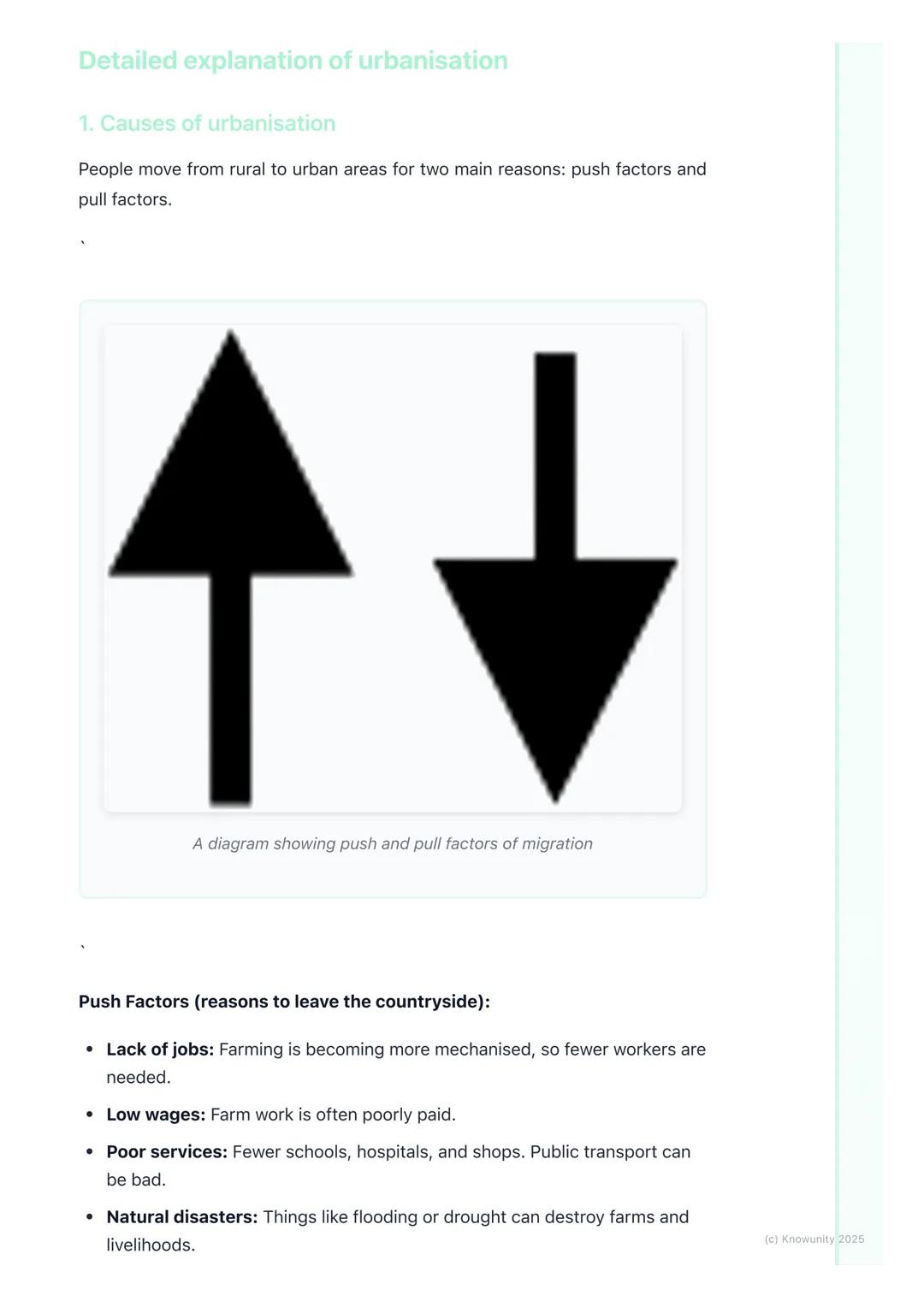
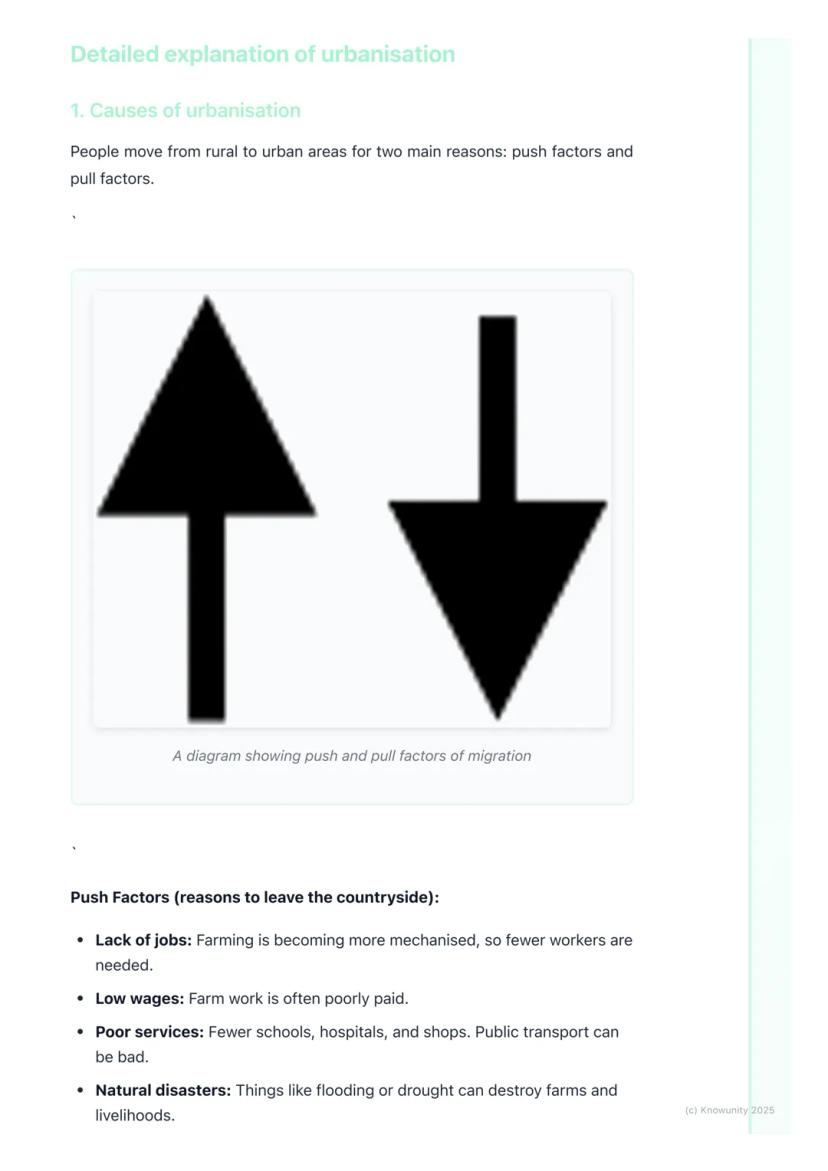
People migrate to cities because of both push factors (reasons to leave rural areas) and pull factors (attractions of urban areas). These work together to drive urbanisation.
Push factors include the lack of rural jobs as farming becomes more mechanised. Low wages in agriculture compared to city jobs push people away, as do poor services like limited schools and healthcare in rural areas. Natural disasters like floods or droughts can destroy farms and force people to relocate, while isolation from opportunities and social networks can make rural living less appealing.
Pull factors drawing people to cities include greater job opportunities in factories, offices, and service industries. The promise of higher wages is a major attraction, along with better services like education, healthcare, and entertainment. Many people perceive a better quality of life in cities, with more excitement and modern amenities.
Remember this: For your exams, always pair push and pull factors together - they're two sides of the same migration coin!
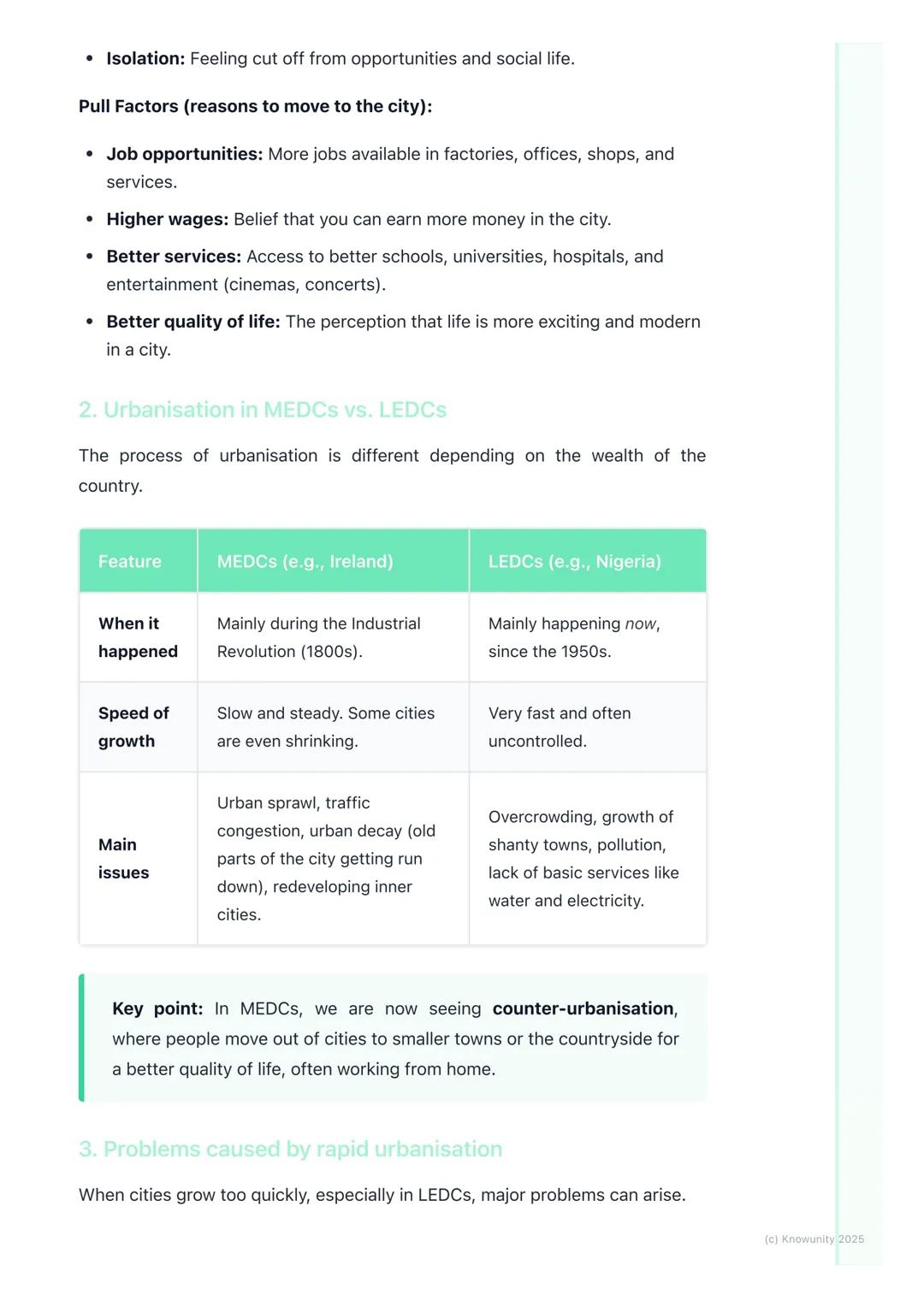
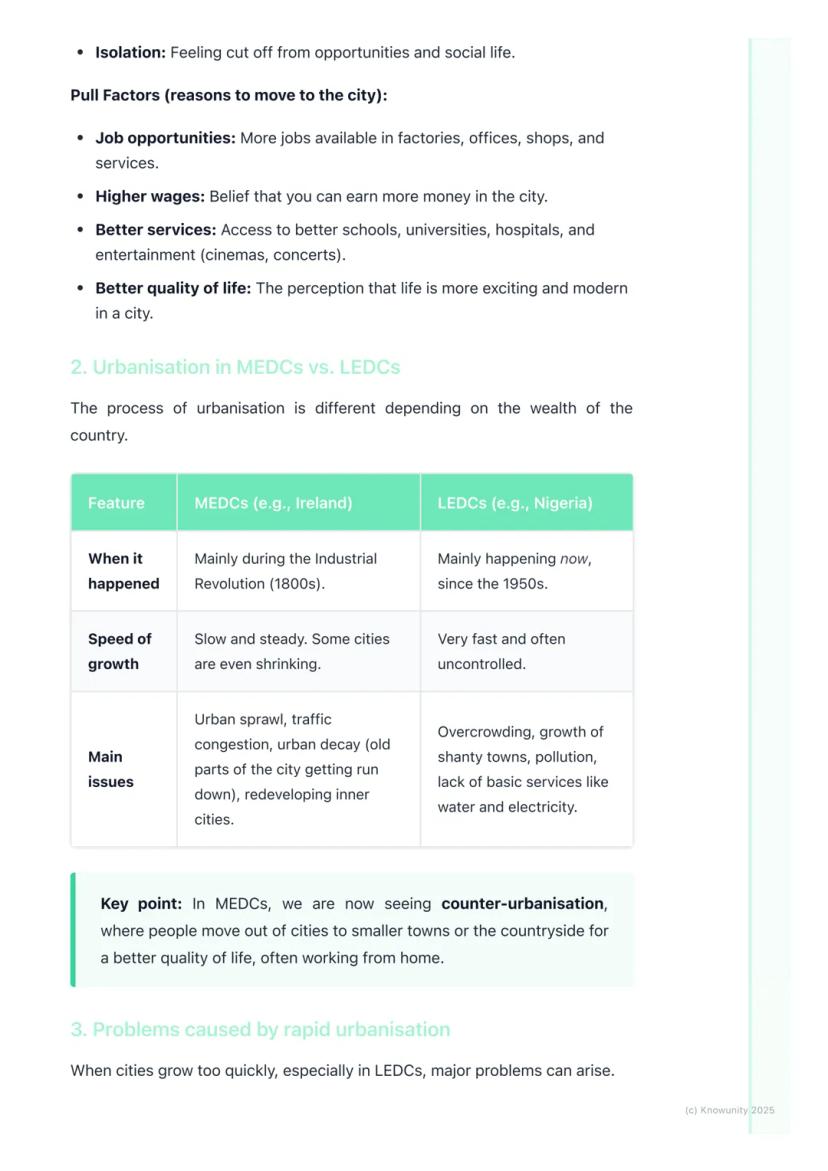
Urbanisation looks quite different depending on a country's wealth and development stage. In MEDCs (More Economically Developed Countries) like Ireland, urbanisation happened mainly during the Industrial Revolution in the 1800s. Growth was slow and steady, with some cities now even shrinking.
By contrast, in LEDCs (Less Economically Developed Countries) like Nigeria, urbanisation is happening now at a very fast, often uncontrolled pace. This speed creates different challenges - while MEDCs struggle with urban sprawl, traffic congestion and urban decay, LEDCs face overwhelming problems with overcrowding, shanty towns, and lack of basic services.
Interestingly, many MEDCs are now experiencing counter-urbanisation, where people move out of cities to smaller towns or rural areas for a better quality of life. This trend has been accelerated by remote working opportunities, allowing people to enjoy rural living while keeping urban jobs.
Exam tip: Make sure you can explain specific differences between urbanisation in MEDCs and LEDCs - examiners love comparing these patterns!
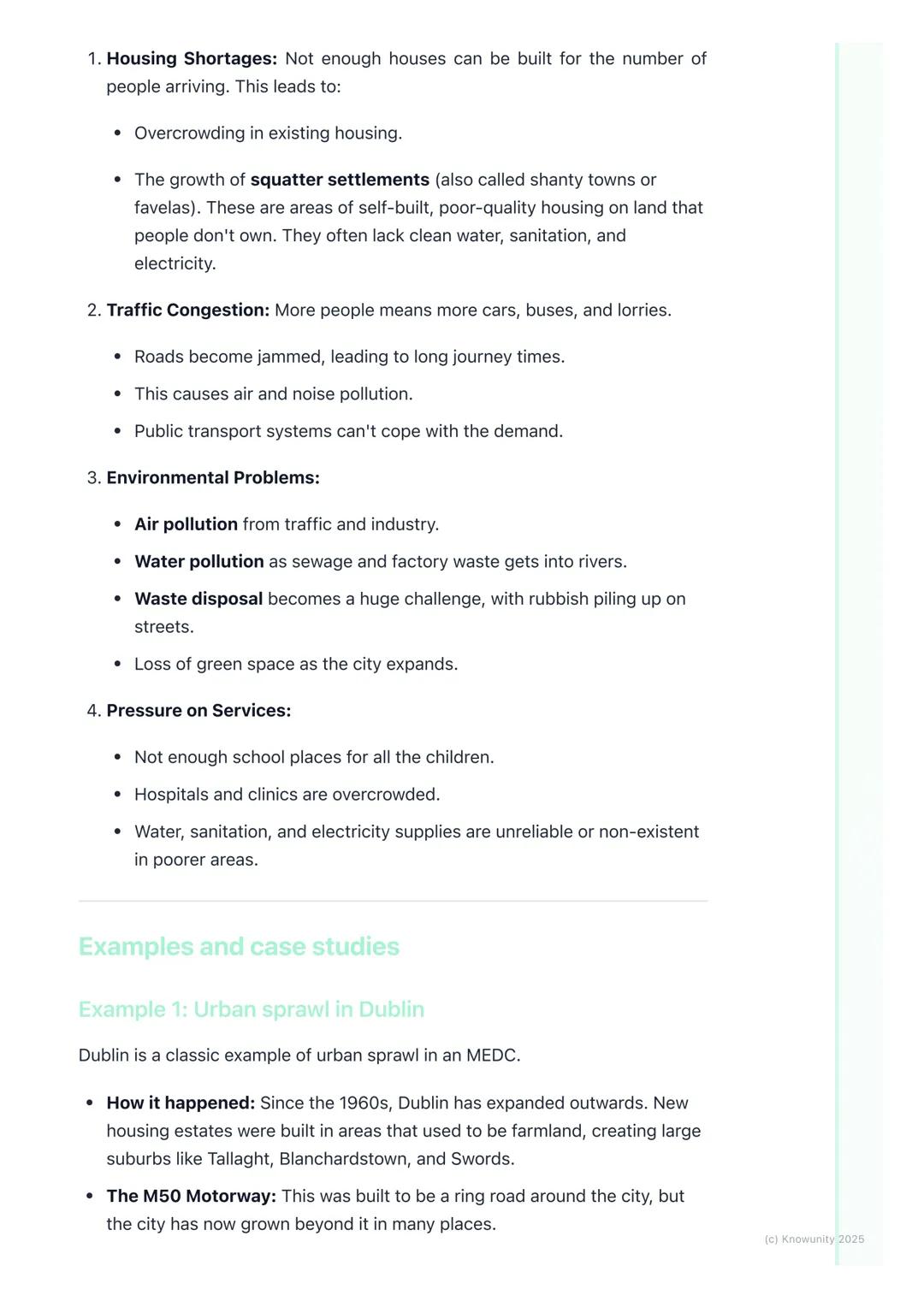
When cities grow too quickly, especially in developing countries, they face serious challenges. Housing shortages occur when construction can't keep pace with migration, leading to overcrowding and the growth of squatter settlements (also called shanty towns or favelas) - areas with poor-quality self-built housing lacking basic services.
Traffic congestion becomes a major headache as roads become jammed with vehicles. This not only wastes time but creates air and noise pollution. Public transport systems struggle to meet the increasing demand, making the problem worse.
Environmental problems multiply in rapidly growing cities. Air pollution from traffic and industry can reach dangerous levels, while water pollution occurs when sewage and factory waste contaminate rivers. Waste disposal becomes a massive challenge, and green spaces disappear as cities expand.
The pressure on public services becomes intense. Schools can't provide enough places, hospitals become overcrowded, and utilities like water and electricity become unreliable or completely unavailable in poorer areas.
Think about this: Many of the problems of urbanisation are interconnected. For example, traffic congestion leads to air pollution, which causes health problems, putting more pressure on hospitals!
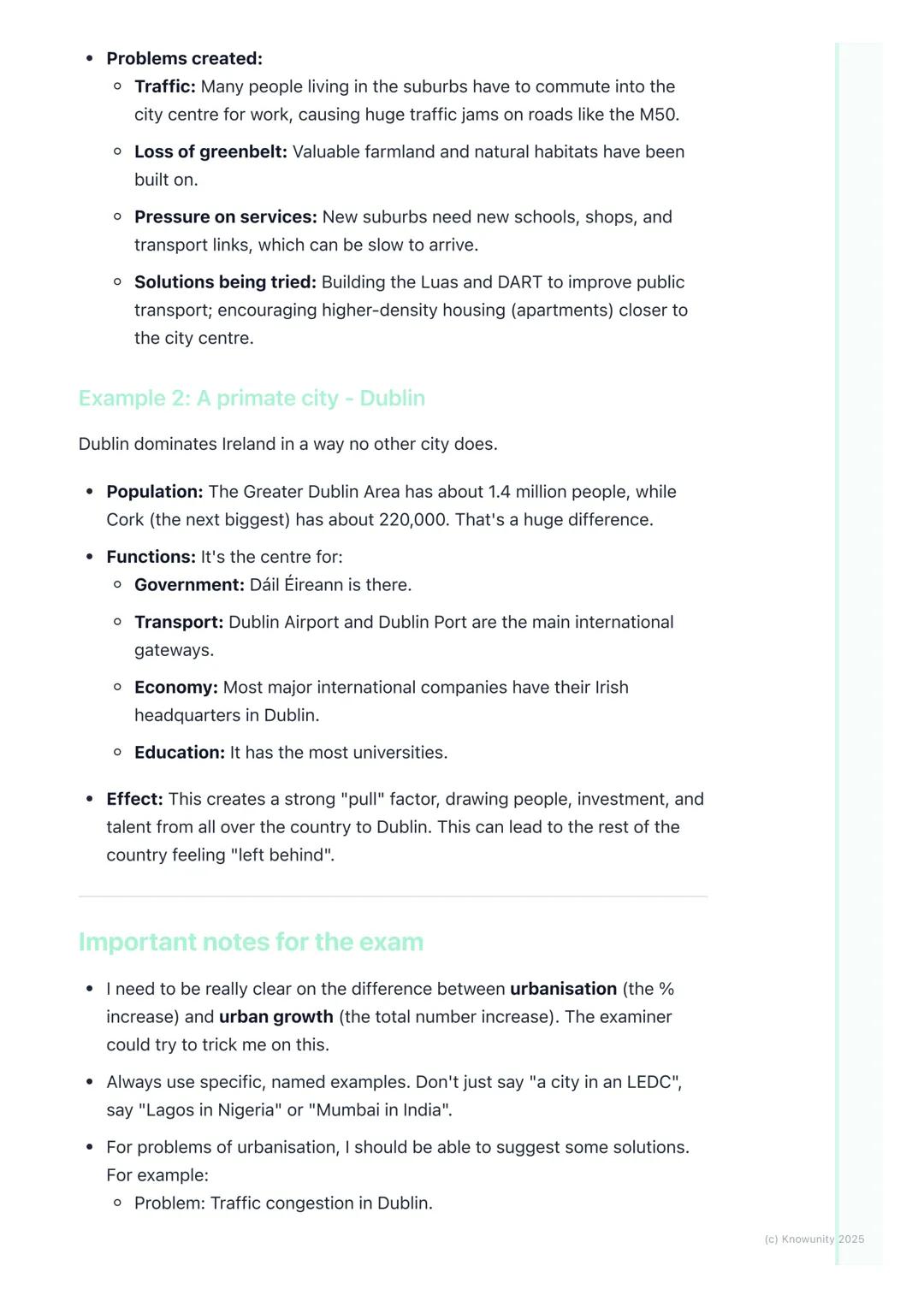
Dublin provides excellent examples of urban issues in an MEDC. Since the 1960s, urban sprawl has transformed Dublin as it expanded outwards. New housing estates were built on former farmland, creating large suburbs like Tallaght and Blanchardstown. Even the M50 motorway, originally designed as a ring road around the city, has been engulfed as the city expanded beyond it.
This sprawl has created significant problems. Traffic congestion is severe as suburbanites commute into the city centre. Valuable farmland and natural habitats have been lost to development. New suburbs often lack adequate services initially, putting pressure on existing infrastructure. Solutions being implemented include expanding the Luas and DART systems and encouraging higher-density housing closer to the city centre.
Dublin is also a classic primate city, dominating Ireland demographically, economically and politically. With about 1.4 million people in the Greater Dublin Area (compared to Cork's 220,000), it serves as the centre for government, transport, economy, and education. This creates a strong "pull" effect, drawing people and investment from all over Ireland, sometimes leaving other regions feeling neglected.
For your exam: Be able to explain how Dublin exemplifies both urban sprawl and the primate city concept - these are perfect examples from right here in Ireland!
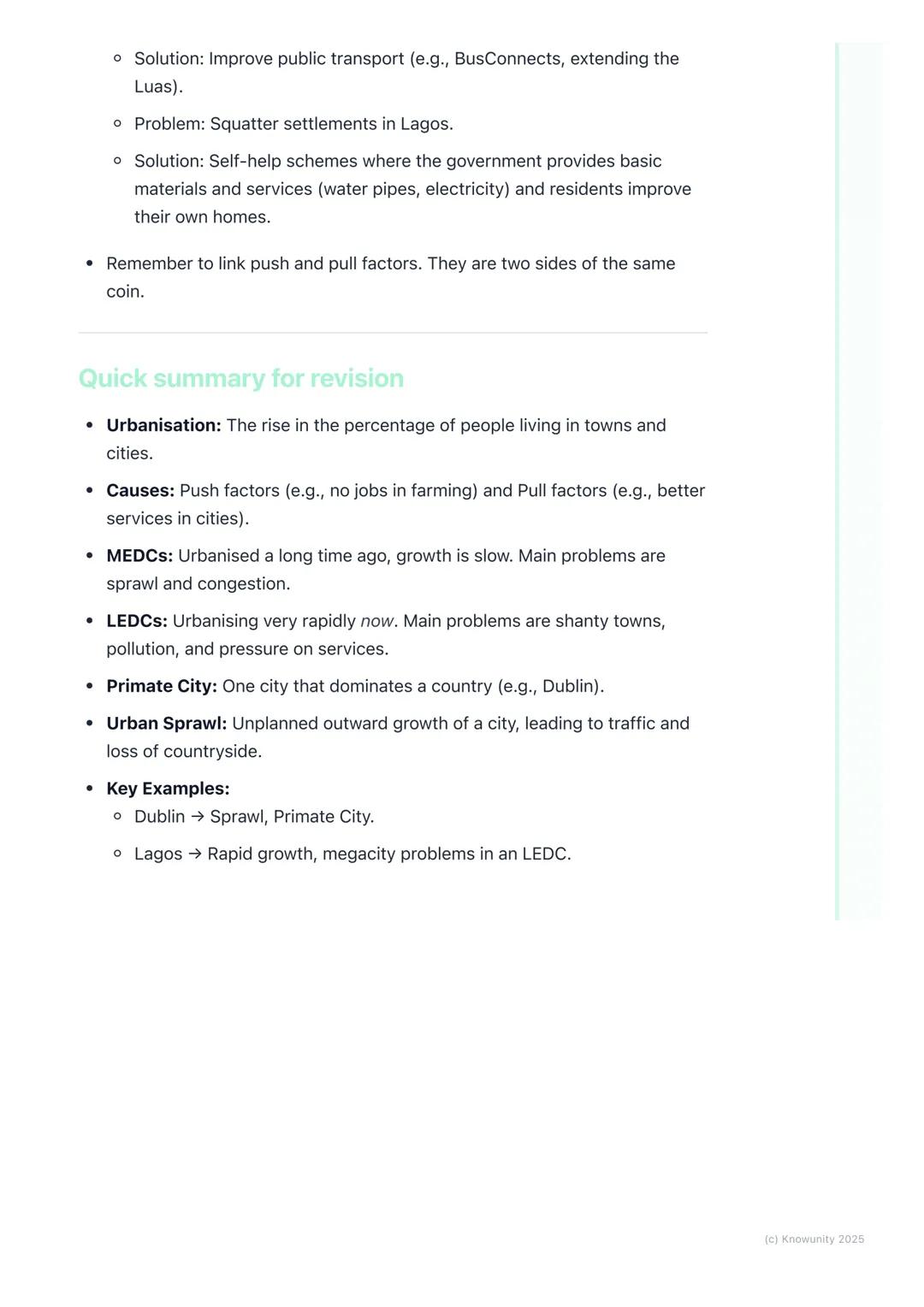
When preparing for exams on urbanisation, focus on clarity and specificity. Be very clear about the difference between urbanisation (the percentage increase of urban population) and urban growth (the total population increase) - examiners often test this distinction.
Always use specific, named examples rather than general statements. Instead of "a city in an LEDC," say "Lagos in Nigeria" or "Mumbai in India." This shows deeper understanding and application of concepts.
For problems of urbanisation, be ready to suggest solutions. For traffic congestion in Dublin, mention improving public transport through BusConnects or Luas extensions. For squatter settlements in Lagos, discuss self-help schemes where governments provide basic materials and services while residents improve their homes.
Remember these key concepts: urbanisation is driven by push and pull factors; MEDCs urbanised long ago while LEDCs are urbanising rapidly now; urban sprawl creates traffic problems and loss of countryside; and primate cities dominate their countries economically and politically. Key examples to know include Dublin (sprawl, primate city) and Lagos (rapid growth, megacity problems).
Confidence booster: Urbanisation might seem complex, but by breaking it down into causes, effects and examples, you'll master this topic and be ready to tackle any exam question!
Nuestro compañero de IA está específicamente adaptado a las necesidades de los estudiantes. Basándonos en los millones de contenidos que tenemos en la plataforma, podemos dar a los estudiantes respuestas realmente significativas y relevantes. Pero no se trata solo de respuestas, el compañero también guía a los estudiantes a través de sus retos de aprendizaje diarios, con planes de aprendizaje personalizados, cuestionarios o contenidos en el chat y una personalización del 100% basada en las habilidades y el desarrollo de los estudiantes.
Puedes descargar la app en Google Play Store y Apple App Store.
¡Sí lo es! Tienes acceso totalmente gratuito a todo el contenido de la app, puedes chatear con otros alumnos y recibir ayuda inmeditamente. Puedes ganar dinero utilizando la aplicación, que te permitirá acceder a determinadas funciones.
App Store
Google Play
La app es muy fácil de usar y está muy bien diseñada. Hasta ahora he encontrado todo lo que estaba buscando y he podido aprender mucho de las presentaciones. Definitivamente utilizaré la aplicación para un examen de clase. Y, por supuesto, también me sirve mucho de inspiración.
Pablo
usuario de iOS
Esta app es realmente genial. Hay tantos apuntes de clase y ayuda [...]. Tengo problemas con matemáticas, por ejemplo, y la aplicación tiene muchas opciones de ayuda. Gracias a Knowunity, he mejorado en mates. Se la recomiendo a todo el mundo.
Elena
usuaria de Android
Vaya, estoy realmente sorprendida. Acabo de probar la app porque la he visto anunciada muchas veces y me he quedado absolutamente alucinada. Esta app es LA AYUDA que quieres para el insti y, sobre todo, ofrece muchísimas cosas, como ejercicios y hojas informativas, que a mí personalmente me han sido MUY útiles.
Ana
usuaria de iOS
Solía tener dificultades para completar mis tareas a tiempo hasta que descubrí Knowunity, que no solo facilita subir mi propio contenido sino que también proporciona excelentes resúmenes que hacen mi trabajo más rápido y eficiente.
Thomas R
usuario de iOS
Siempre era un desafío encontrar toda la información importante para mis tareas – desde que comencé a usar Knowunity, puedo simplemente subir mi contenido y beneficiarme de los resúmenes de otros, lo que me ayuda mucho con la organización.
Lisa M
usuario de Android
A menudo sentía que no tenía suficiente visión general al estudiar, pero desde que comencé a usar Knowunity, eso ya no es un problema – subo mi contenido y siempre encuentro resúmenes útiles en la plataforma, lo que hace mi aprendizaje mucho más fácil.
David K
usuario de iOS
¡La app es buenísima! Sólo tengo que introducir el tema en la barra de búsqueda y recibo la respuesta muy rápido. No tengo que ver 10 vídeos de YouTube para entender algo, así que me ahorro tiempo. ¡Muy recomendable!
Sara
usuaria de Android
En el instituto era muy malo en matemáticas, pero gracias a la app, ahora saco mejores notas. Os agradezco mucho que hayáis creado la aplicación.
Roberto
usuario de Android
Solía ser muy difícil reunir toda la información para mis presentaciones. Pero desde que comencé a usar Knowunity, solo subo mis notas y encuentro increíbles resúmenes de otros – ¡hace mi estudio mucho más eficiente!
Julia S
usuario de Android
Siempre estaba estresado con todo el material de estudio, pero desde que comencé a usar Knowunity, subo mis cosas y reviso los geniales resúmenes de otros – realmente me ayuda a manejar todo mejor y es mucho menos estresante.
Marco B
usuario de iOS
LOS QUIZZES Y FLASHCARDS SON SÚPER ÚTILES Y AMO Knowunity AI. TAMBIÉN ES LITERALMENTE COMO CHATGPT PERO MÁS INTELIGENTE!! ME AYUDÓ CON MIS PROBLEMAS DE RÍMEL TAMBIÉN!! Y CON MIS MATERIAS REALES OBVIO! 😍😁😲🤑💗✨🎀😮
Sarah L
usuario de Android
Antes pasaba horas buscando en Google materiales escolares, pero ahora solo subo mis cosas a Knowunity y reviso los útiles resúmenes de otros – me siento mucho más seguro cuando me preparo para los exámenes.
Paul T
usuario de iOS
La app es muy fácil de usar y está muy bien diseñada. Hasta ahora he encontrado todo lo que estaba buscando y he podido aprender mucho de las presentaciones. Definitivamente utilizaré la aplicación para un examen de clase. Y, por supuesto, también me sirve mucho de inspiración.
Pablo
usuario de iOS
Esta app es realmente genial. Hay tantos apuntes de clase y ayuda [...]. Tengo problemas con matemáticas, por ejemplo, y la aplicación tiene muchas opciones de ayuda. Gracias a Knowunity, he mejorado en mates. Se la recomiendo a todo el mundo.
Elena
usuaria de Android
Vaya, estoy realmente sorprendida. Acabo de probar la app porque la he visto anunciada muchas veces y me he quedado absolutamente alucinada. Esta app es LA AYUDA que quieres para el insti y, sobre todo, ofrece muchísimas cosas, como ejercicios y hojas informativas, que a mí personalmente me han sido MUY útiles.
Ana
usuaria de iOS
Solía tener dificultades para completar mis tareas a tiempo hasta que descubrí Knowunity, que no solo facilita subir mi propio contenido sino que también proporciona excelentes resúmenes que hacen mi trabajo más rápido y eficiente.
Thomas R
usuario de iOS
Siempre era un desafío encontrar toda la información importante para mis tareas – desde que comencé a usar Knowunity, puedo simplemente subir mi contenido y beneficiarme de los resúmenes de otros, lo que me ayuda mucho con la organización.
Lisa M
usuario de Android
A menudo sentía que no tenía suficiente visión general al estudiar, pero desde que comencé a usar Knowunity, eso ya no es un problema – subo mi contenido y siempre encuentro resúmenes útiles en la plataforma, lo que hace mi aprendizaje mucho más fácil.
David K
usuario de iOS
¡La app es buenísima! Sólo tengo que introducir el tema en la barra de búsqueda y recibo la respuesta muy rápido. No tengo que ver 10 vídeos de YouTube para entender algo, así que me ahorro tiempo. ¡Muy recomendable!
Sara
usuaria de Android
En el instituto era muy malo en matemáticas, pero gracias a la app, ahora saco mejores notas. Os agradezco mucho que hayáis creado la aplicación.
Roberto
usuario de Android
Solía ser muy difícil reunir toda la información para mis presentaciones. Pero desde que comencé a usar Knowunity, solo subo mis notas y encuentro increíbles resúmenes de otros – ¡hace mi estudio mucho más eficiente!
Julia S
usuario de Android
Siempre estaba estresado con todo el material de estudio, pero desde que comencé a usar Knowunity, subo mis cosas y reviso los geniales resúmenes de otros – realmente me ayuda a manejar todo mejor y es mucho menos estresante.
Marco B
usuario de iOS
LOS QUIZZES Y FLASHCARDS SON SÚPER ÚTILES Y AMO Knowunity AI. TAMBIÉN ES LITERALMENTE COMO CHATGPT PERO MÁS INTELIGENTE!! ME AYUDÓ CON MIS PROBLEMAS DE RÍMEL TAMBIÉN!! Y CON MIS MATERIAS REALES OBVIO! 😍😁😲🤑💗✨🎀😮
Sarah L
usuario de Android
Antes pasaba horas buscando en Google materiales escolares, pero ahora solo subo mis cosas a Knowunity y reviso los útiles resúmenes de otros – me siento mucho más seguro cuando me preparo para los exámenes.
Paul T
usuario de iOS
Urbanisation is the process where more and more people move from rural areas to live in towns and cities. This global trend has accelerated in recent decades, reshaping our landscapes and societies. Understanding urbanisation helps us grasp why cities grow,... Mostrar más
Acceso a todos los documentos
Mejora tus notas
Únete a millones de estudiantes
When studying settlements, we need to understand some key differences. A settlement is any place where people live, from isolated houses to massive cities. Urban areas are towns and cities, while rural refers to the countryside.
Urbanisation specifically means the increasing percentage of people living in urban areas. It's not just about cities getting bigger, but about the population balance shifting from rural to urban. Urban growth refers to the physical expansion of a city's area and total population.
Cities develop in different ways. Urban sprawl is the poorly planned spread of a city into surrounding countryside, often through housing estates and car-dependent living. Megacities have populations over 10 million (like Tokyo), while primate cities dominate their countries economically and politically (Dublin is Ireland's primate city).
Did you know? The world is becoming increasingly urban. In 1950, only 30% of people lived in cities, but today it's over 55%, and by 2050 it could reach 68%!
Acceso a todos los documentos
Mejora tus notas
Únete a millones de estudiantes
People migrate to cities because of both push factors (reasons to leave rural areas) and pull factors (attractions of urban areas). These work together to drive urbanisation.
Push factors include the lack of rural jobs as farming becomes more mechanised. Low wages in agriculture compared to city jobs push people away, as do poor services like limited schools and healthcare in rural areas. Natural disasters like floods or droughts can destroy farms and force people to relocate, while isolation from opportunities and social networks can make rural living less appealing.
Pull factors drawing people to cities include greater job opportunities in factories, offices, and service industries. The promise of higher wages is a major attraction, along with better services like education, healthcare, and entertainment. Many people perceive a better quality of life in cities, with more excitement and modern amenities.
Remember this: For your exams, always pair push and pull factors together - they're two sides of the same migration coin!
Acceso a todos los documentos
Mejora tus notas
Únete a millones de estudiantes
Urbanisation looks quite different depending on a country's wealth and development stage. In MEDCs (More Economically Developed Countries) like Ireland, urbanisation happened mainly during the Industrial Revolution in the 1800s. Growth was slow and steady, with some cities now even shrinking.
By contrast, in LEDCs (Less Economically Developed Countries) like Nigeria, urbanisation is happening now at a very fast, often uncontrolled pace. This speed creates different challenges - while MEDCs struggle with urban sprawl, traffic congestion and urban decay, LEDCs face overwhelming problems with overcrowding, shanty towns, and lack of basic services.
Interestingly, many MEDCs are now experiencing counter-urbanisation, where people move out of cities to smaller towns or rural areas for a better quality of life. This trend has been accelerated by remote working opportunities, allowing people to enjoy rural living while keeping urban jobs.
Exam tip: Make sure you can explain specific differences between urbanisation in MEDCs and LEDCs - examiners love comparing these patterns!
Acceso a todos los documentos
Mejora tus notas
Únete a millones de estudiantes
When cities grow too quickly, especially in developing countries, they face serious challenges. Housing shortages occur when construction can't keep pace with migration, leading to overcrowding and the growth of squatter settlements (also called shanty towns or favelas) - areas with poor-quality self-built housing lacking basic services.
Traffic congestion becomes a major headache as roads become jammed with vehicles. This not only wastes time but creates air and noise pollution. Public transport systems struggle to meet the increasing demand, making the problem worse.
Environmental problems multiply in rapidly growing cities. Air pollution from traffic and industry can reach dangerous levels, while water pollution occurs when sewage and factory waste contaminate rivers. Waste disposal becomes a massive challenge, and green spaces disappear as cities expand.
The pressure on public services becomes intense. Schools can't provide enough places, hospitals become overcrowded, and utilities like water and electricity become unreliable or completely unavailable in poorer areas.
Think about this: Many of the problems of urbanisation are interconnected. For example, traffic congestion leads to air pollution, which causes health problems, putting more pressure on hospitals!
Acceso a todos los documentos
Mejora tus notas
Únete a millones de estudiantes
Dublin provides excellent examples of urban issues in an MEDC. Since the 1960s, urban sprawl has transformed Dublin as it expanded outwards. New housing estates were built on former farmland, creating large suburbs like Tallaght and Blanchardstown. Even the M50 motorway, originally designed as a ring road around the city, has been engulfed as the city expanded beyond it.
This sprawl has created significant problems. Traffic congestion is severe as suburbanites commute into the city centre. Valuable farmland and natural habitats have been lost to development. New suburbs often lack adequate services initially, putting pressure on existing infrastructure. Solutions being implemented include expanding the Luas and DART systems and encouraging higher-density housing closer to the city centre.
Dublin is also a classic primate city, dominating Ireland demographically, economically and politically. With about 1.4 million people in the Greater Dublin Area (compared to Cork's 220,000), it serves as the centre for government, transport, economy, and education. This creates a strong "pull" effect, drawing people and investment from all over Ireland, sometimes leaving other regions feeling neglected.
For your exam: Be able to explain how Dublin exemplifies both urban sprawl and the primate city concept - these are perfect examples from right here in Ireland!
Acceso a todos los documentos
Mejora tus notas
Únete a millones de estudiantes
When preparing for exams on urbanisation, focus on clarity and specificity. Be very clear about the difference between urbanisation (the percentage increase of urban population) and urban growth (the total population increase) - examiners often test this distinction.
Always use specific, named examples rather than general statements. Instead of "a city in an LEDC," say "Lagos in Nigeria" or "Mumbai in India." This shows deeper understanding and application of concepts.
For problems of urbanisation, be ready to suggest solutions. For traffic congestion in Dublin, mention improving public transport through BusConnects or Luas extensions. For squatter settlements in Lagos, discuss self-help schemes where governments provide basic materials and services while residents improve their homes.
Remember these key concepts: urbanisation is driven by push and pull factors; MEDCs urbanised long ago while LEDCs are urbanising rapidly now; urban sprawl creates traffic problems and loss of countryside; and primate cities dominate their countries economically and politically. Key examples to know include Dublin (sprawl, primate city) and Lagos (rapid growth, megacity problems).
Confidence booster: Urbanisation might seem complex, but by breaking it down into causes, effects and examples, you'll master this topic and be ready to tackle any exam question!
Nuestro compañero de IA está específicamente adaptado a las necesidades de los estudiantes. Basándonos en los millones de contenidos que tenemos en la plataforma, podemos dar a los estudiantes respuestas realmente significativas y relevantes. Pero no se trata solo de respuestas, el compañero también guía a los estudiantes a través de sus retos de aprendizaje diarios, con planes de aprendizaje personalizados, cuestionarios o contenidos en el chat y una personalización del 100% basada en las habilidades y el desarrollo de los estudiantes.
Puedes descargar la app en Google Play Store y Apple App Store.
¡Sí lo es! Tienes acceso totalmente gratuito a todo el contenido de la app, puedes chatear con otros alumnos y recibir ayuda inmeditamente. Puedes ganar dinero utilizando la aplicación, que te permitirá acceder a determinadas funciones.
0
Herramientas Inteligentes NUEVO
Convierte estos apuntes en: ✓ 50+ Preguntas de Práctica ✓ Tarjetas de Estudio Interactivas ✓ Examen Completo de Práctica ✓ Esquemas de Ensayo
App Store
Google Play
La app es muy fácil de usar y está muy bien diseñada. Hasta ahora he encontrado todo lo que estaba buscando y he podido aprender mucho de las presentaciones. Definitivamente utilizaré la aplicación para un examen de clase. Y, por supuesto, también me sirve mucho de inspiración.
Pablo
usuario de iOS
Esta app es realmente genial. Hay tantos apuntes de clase y ayuda [...]. Tengo problemas con matemáticas, por ejemplo, y la aplicación tiene muchas opciones de ayuda. Gracias a Knowunity, he mejorado en mates. Se la recomiendo a todo el mundo.
Elena
usuaria de Android
Vaya, estoy realmente sorprendida. Acabo de probar la app porque la he visto anunciada muchas veces y me he quedado absolutamente alucinada. Esta app es LA AYUDA que quieres para el insti y, sobre todo, ofrece muchísimas cosas, como ejercicios y hojas informativas, que a mí personalmente me han sido MUY útiles.
Ana
usuaria de iOS
Solía tener dificultades para completar mis tareas a tiempo hasta que descubrí Knowunity, que no solo facilita subir mi propio contenido sino que también proporciona excelentes resúmenes que hacen mi trabajo más rápido y eficiente.
Thomas R
usuario de iOS
Siempre era un desafío encontrar toda la información importante para mis tareas – desde que comencé a usar Knowunity, puedo simplemente subir mi contenido y beneficiarme de los resúmenes de otros, lo que me ayuda mucho con la organización.
Lisa M
usuario de Android
A menudo sentía que no tenía suficiente visión general al estudiar, pero desde que comencé a usar Knowunity, eso ya no es un problema – subo mi contenido y siempre encuentro resúmenes útiles en la plataforma, lo que hace mi aprendizaje mucho más fácil.
David K
usuario de iOS
¡La app es buenísima! Sólo tengo que introducir el tema en la barra de búsqueda y recibo la respuesta muy rápido. No tengo que ver 10 vídeos de YouTube para entender algo, así que me ahorro tiempo. ¡Muy recomendable!
Sara
usuaria de Android
En el instituto era muy malo en matemáticas, pero gracias a la app, ahora saco mejores notas. Os agradezco mucho que hayáis creado la aplicación.
Roberto
usuario de Android
Solía ser muy difícil reunir toda la información para mis presentaciones. Pero desde que comencé a usar Knowunity, solo subo mis notas y encuentro increíbles resúmenes de otros – ¡hace mi estudio mucho más eficiente!
Julia S
usuario de Android
Siempre estaba estresado con todo el material de estudio, pero desde que comencé a usar Knowunity, subo mis cosas y reviso los geniales resúmenes de otros – realmente me ayuda a manejar todo mejor y es mucho menos estresante.
Marco B
usuario de iOS
LOS QUIZZES Y FLASHCARDS SON SÚPER ÚTILES Y AMO Knowunity AI. TAMBIÉN ES LITERALMENTE COMO CHATGPT PERO MÁS INTELIGENTE!! ME AYUDÓ CON MIS PROBLEMAS DE RÍMEL TAMBIÉN!! Y CON MIS MATERIAS REALES OBVIO! 😍😁😲🤑💗✨🎀😮
Sarah L
usuario de Android
Antes pasaba horas buscando en Google materiales escolares, pero ahora solo subo mis cosas a Knowunity y reviso los útiles resúmenes de otros – me siento mucho más seguro cuando me preparo para los exámenes.
Paul T
usuario de iOS
La app es muy fácil de usar y está muy bien diseñada. Hasta ahora he encontrado todo lo que estaba buscando y he podido aprender mucho de las presentaciones. Definitivamente utilizaré la aplicación para un examen de clase. Y, por supuesto, también me sirve mucho de inspiración.
Pablo
usuario de iOS
Esta app es realmente genial. Hay tantos apuntes de clase y ayuda [...]. Tengo problemas con matemáticas, por ejemplo, y la aplicación tiene muchas opciones de ayuda. Gracias a Knowunity, he mejorado en mates. Se la recomiendo a todo el mundo.
Elena
usuaria de Android
Vaya, estoy realmente sorprendida. Acabo de probar la app porque la he visto anunciada muchas veces y me he quedado absolutamente alucinada. Esta app es LA AYUDA que quieres para el insti y, sobre todo, ofrece muchísimas cosas, como ejercicios y hojas informativas, que a mí personalmente me han sido MUY útiles.
Ana
usuaria de iOS
Solía tener dificultades para completar mis tareas a tiempo hasta que descubrí Knowunity, que no solo facilita subir mi propio contenido sino que también proporciona excelentes resúmenes que hacen mi trabajo más rápido y eficiente.
Thomas R
usuario de iOS
Siempre era un desafío encontrar toda la información importante para mis tareas – desde que comencé a usar Knowunity, puedo simplemente subir mi contenido y beneficiarme de los resúmenes de otros, lo que me ayuda mucho con la organización.
Lisa M
usuario de Android
A menudo sentía que no tenía suficiente visión general al estudiar, pero desde que comencé a usar Knowunity, eso ya no es un problema – subo mi contenido y siempre encuentro resúmenes útiles en la plataforma, lo que hace mi aprendizaje mucho más fácil.
David K
usuario de iOS
¡La app es buenísima! Sólo tengo que introducir el tema en la barra de búsqueda y recibo la respuesta muy rápido. No tengo que ver 10 vídeos de YouTube para entender algo, así que me ahorro tiempo. ¡Muy recomendable!
Sara
usuaria de Android
En el instituto era muy malo en matemáticas, pero gracias a la app, ahora saco mejores notas. Os agradezco mucho que hayáis creado la aplicación.
Roberto
usuario de Android
Solía ser muy difícil reunir toda la información para mis presentaciones. Pero desde que comencé a usar Knowunity, solo subo mis notas y encuentro increíbles resúmenes de otros – ¡hace mi estudio mucho más eficiente!
Julia S
usuario de Android
Siempre estaba estresado con todo el material de estudio, pero desde que comencé a usar Knowunity, subo mis cosas y reviso los geniales resúmenes de otros – realmente me ayuda a manejar todo mejor y es mucho menos estresante.
Marco B
usuario de iOS
LOS QUIZZES Y FLASHCARDS SON SÚPER ÚTILES Y AMO Knowunity AI. TAMBIÉN ES LITERALMENTE COMO CHATGPT PERO MÁS INTELIGENTE!! ME AYUDÓ CON MIS PROBLEMAS DE RÍMEL TAMBIÉN!! Y CON MIS MATERIAS REALES OBVIO! 😍😁😲🤑💗✨🎀😮
Sarah L
usuario de Android
Antes pasaba horas buscando en Google materiales escolares, pero ahora solo subo mis cosas a Knowunity y reviso los útiles resúmenes de otros – me siento mucho más seguro cuando me preparo para los exámenes.
Paul T
usuario de iOS