
Ever wondered why your phone case is plastic but your... Mostrar más
 Engineering
 Irish
Irish English
Inscríbete para ver los apuntes¡Es gratis!
Acceso a todos los documentos
Mejora tus notas
Únete a millones de estudiantes
Knowunity AI
Asignaturas
Triangle Congruence and Similarity Theorems
Triangle Properties and Classification
Linear Equations and Graphs
Geometric Angle Relationships
Trigonometric Functions and Identities
Equation Solving Techniques
Circle Geometry Fundamentals
Division Operations and Methods
Basic Differentiation Rules
Exponent and Logarithm Properties
Mostrar todos los temas
Human Organ Systems
Reproductive Cell Cycles
Biological Sciences Subdisciplines
Cellular Energy Metabolism
Autotrophic Energy Processes
Inheritance Patterns and Principles
Biomolecular Structure and Organization
Cell Cycle and Division Mechanics
Cellular Organization and Development
Biological Structural Organization
Mostrar todos los temas
Chemical Sciences and Applications
Atomic Structure and Composition
Molecular Electron Structure Representation
Atomic Electron Behavior
Matter Properties and Water
Mole Concept and Calculations
Gas Laws and Behavior
Periodic Table Organization
Chemical Thermodynamics Fundamentals
Chemical Bond Types and Properties
Mostrar todos los temas
European Renaissance and Enlightenment
European Cultural Movements 800-1920
American Revolution Era 1763-1797
American Civil War 1861-1865
Global Imperial Systems
Mongol and Chinese Dynasties
U.S. Presidents and World Leaders
Historical Sources and Documentation
World Wars Era and Impact
World Religious Systems
Mostrar todos los temas
Classic and Contemporary Novels
Literary Character Analysis
Rhetorical Theory and Practice
Classic Literary Narratives
Reading Analysis and Interpretation
Narrative Structure and Techniques
English Language Components
Influential English-Language Authors
Basic Sentence Structure
Narrative Voice and Perspective
Mostrar todos los temas
7
•
Actualizado May 10, 2026
•
Ever wondered why your phone case is plastic but your... Mostrar más
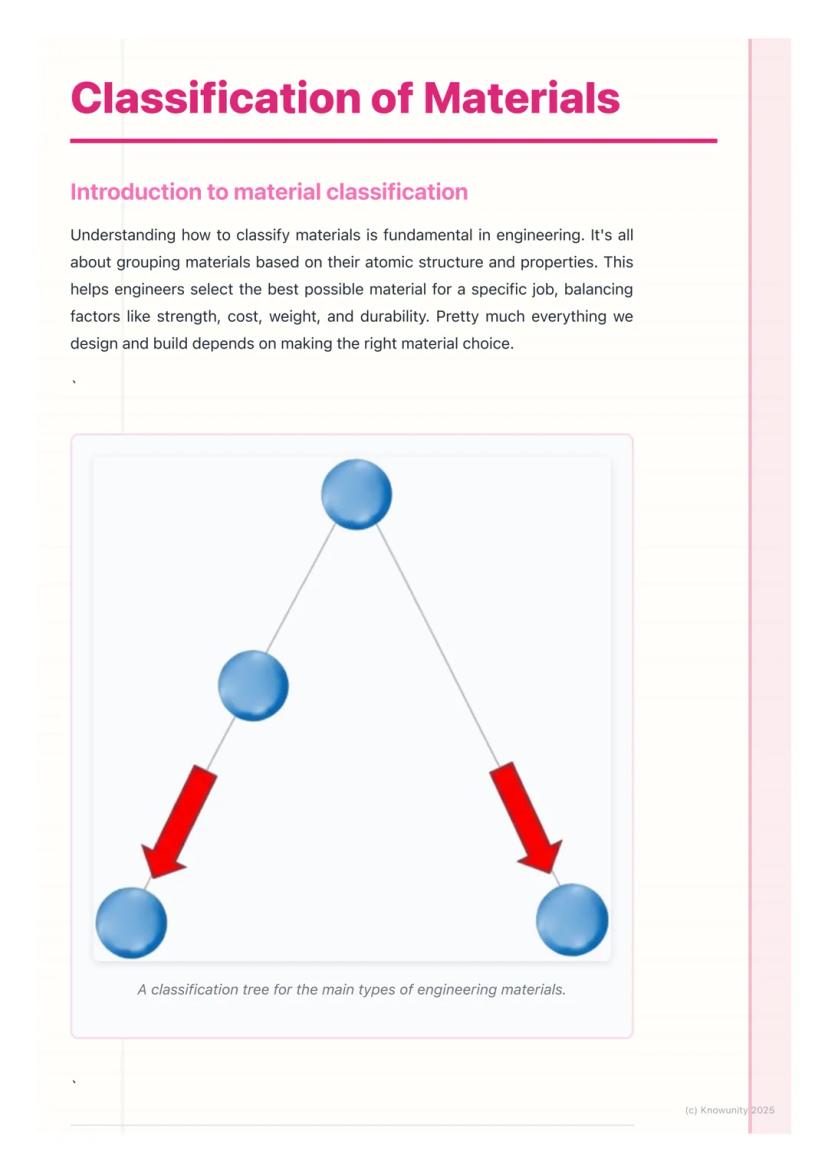
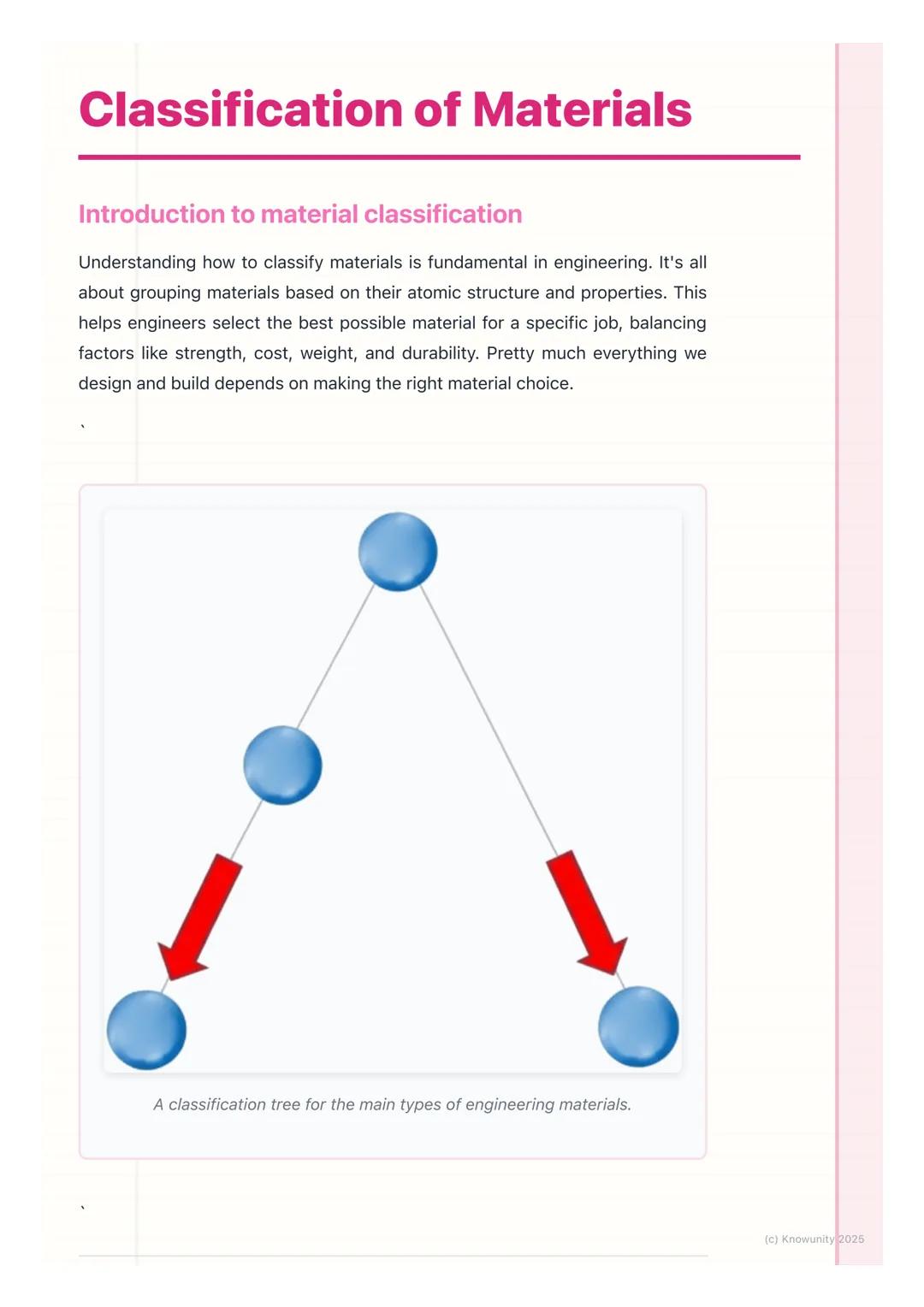
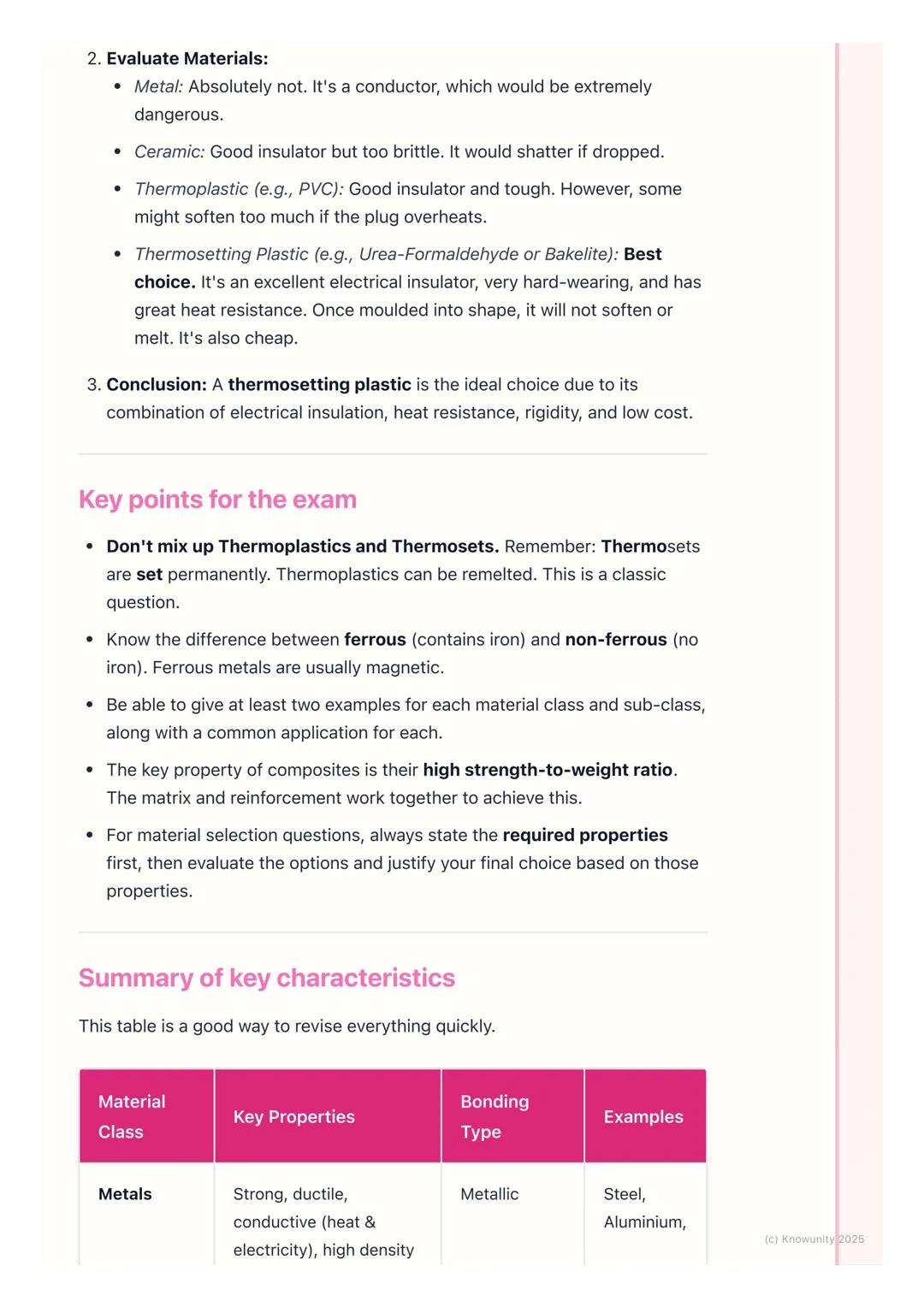
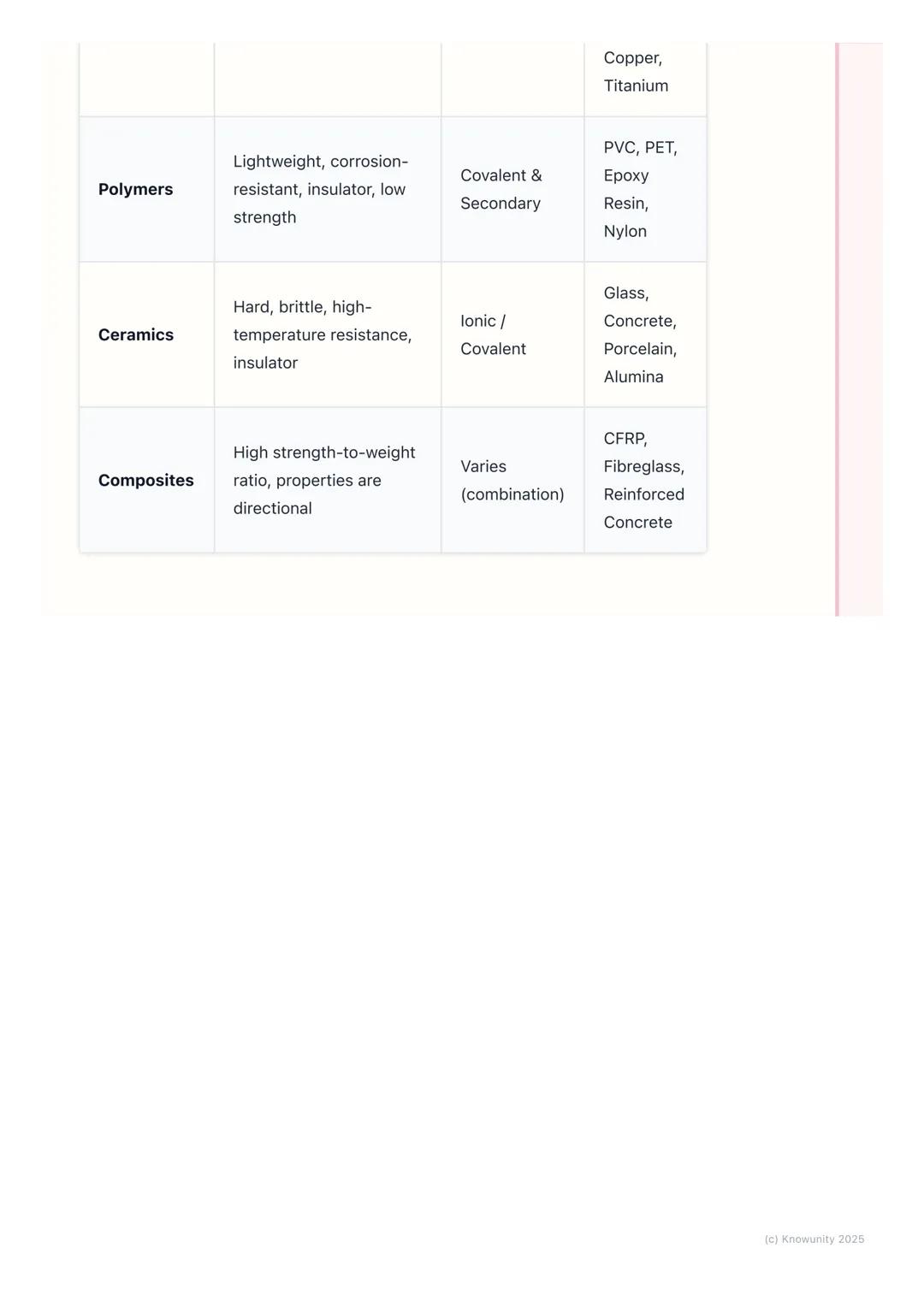
Understanding material classification starts with recognising that all engineering materials fall into four main families based on their atomic structure. This isn't just theory - it's the foundation that helps engineers make smart choices every day.
The four core material families are metals, polymers, ceramics, and composites. Each family has unique properties that make them perfect for different applications. Think of it like choosing the right tool for a job - you wouldn't use a hammer to cut wood!
Classification systems group materials by their atomic bonding and structure. This makes it easier to predict how they'll behave under stress, heat, or in different environments.
Quick Tip: Remember that material choice always comes down to matching properties with requirements - strength, cost, weight, and durability are the big four factors to consider.
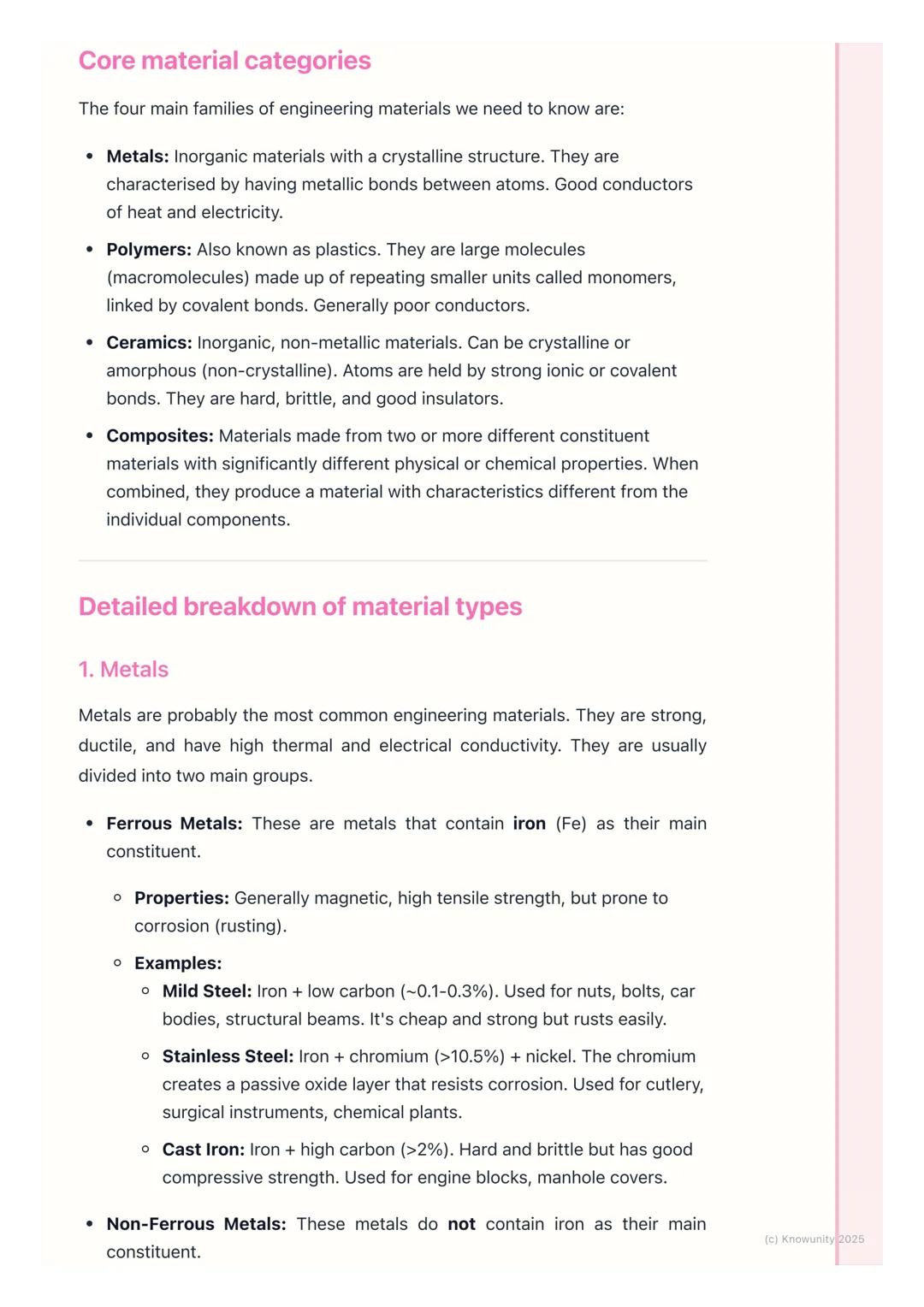
Metals are your go-to materials when you need strength and conductivity. They have metallic bonds between atoms, creating that characteristic ability to conduct heat and electricity. Most of the structural materials around you are metals.
Polymers (plastics) are large molecules made from repeating units called monomers. They're lightweight, corrosion-resistant, and brilliant insulators. The variety of plastics available today is incredible - from soft bin bags to tough car bumpers.
Ceramics are hard, brittle materials held together by strong ionic or covalent bonds. They're fantastic insulators and can handle extreme temperatures, but they'll crack rather than bend under stress.
Composites combine two or more different materials to create something better than either component alone. It's like making a super-material by mixing the best properties of different families together.
Key Insight: Each material family has trade-offs - metals are strong but heavy, polymers are light but weaker, ceramics are hard but brittle, and composites can be engineered for specific needs.
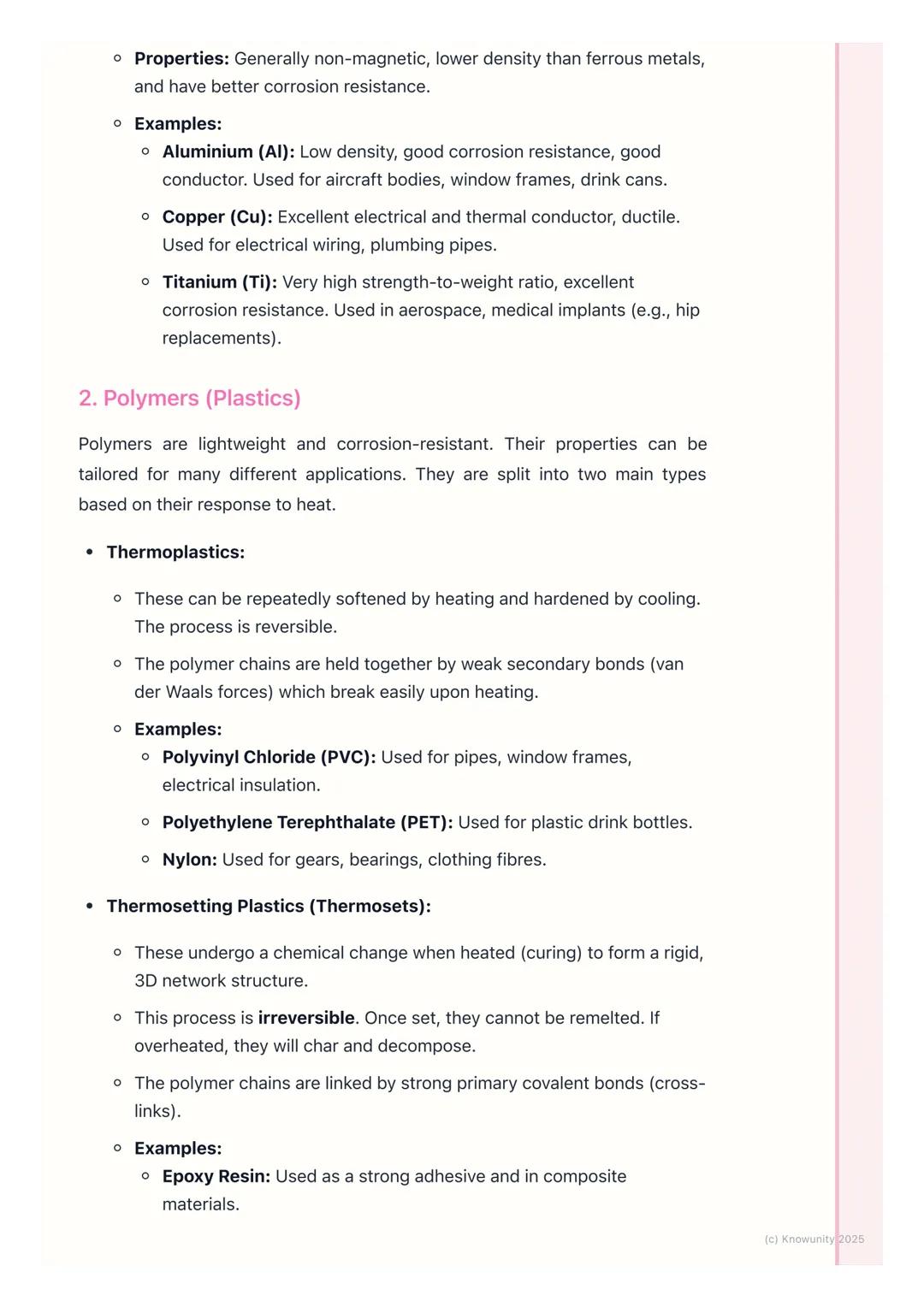
Ferrous metals contain iron as their main ingredient, making them magnetic and generally strong. Mild steel is everywhere - car bodies, structural beams, nuts and bolts. It's cheap and strong but rusts easily unless protected.
Stainless steel adds chromium to create a protective oxide layer that resists corrosion. That's why your kitchen sink doesn't rust! Cast iron has high carbon content, making it hard but brittle - perfect for engine blocks where you need compression strength.
Non-ferrous metals don't contain iron, so they're not magnetic and often resist corrosion better. Aluminium is brilliant for aircraft because it's light yet strong. Copper dominates electrical wiring because it conducts electricity so well.
Titanium is the superstar of metals - incredibly strong for its weight and virtually corrosion-proof. It's expensive, but when you need the best (like in aircraft or medical implants), titanium delivers.
Memory Trick: Ferrous = iron = magnetic. If a magnet sticks to it, it's probably ferrous!
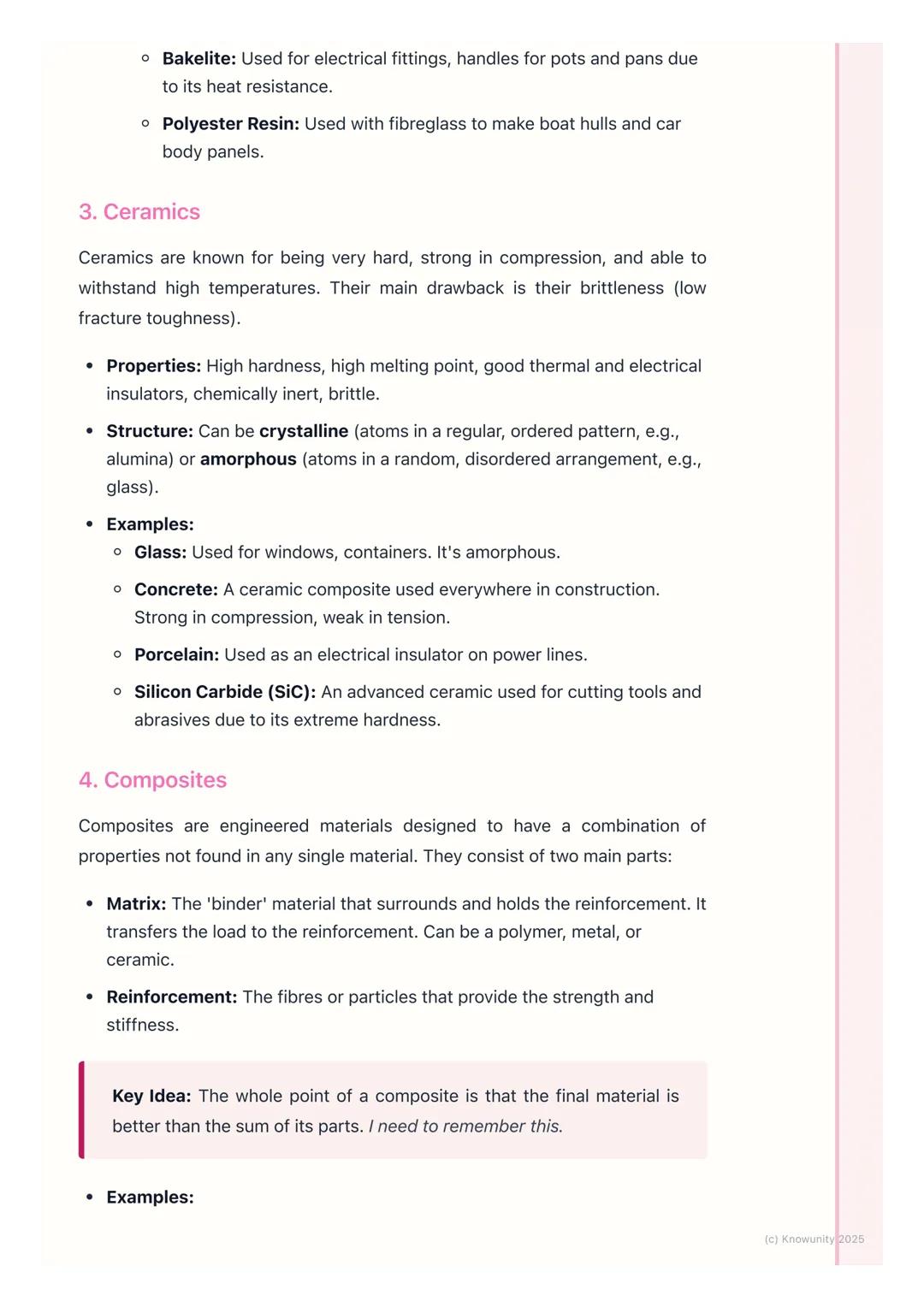
Thermoplastics can be melted and reshaped repeatedly - think of them as the recyclable plastics. Heat them up, they soften; cool them down, they harden. PVC pipes, PET drink bottles, and nylon gears all fall into this category.
The polymer chains in thermoplastics are held by weak forces that break easily when heated. This reversible process is why you can recycle these plastics into new products.
Thermosetting plastics undergo a permanent chemical change when heated - once they're set, that's it. Overheat them and they'll char and decompose rather than melt. Epoxy resin creates incredibly strong adhesives, while Bakelite handles heat brilliantly.
The difference comes down to bonding - thermosets form strong cross-links between polymer chains that can't be broken by reheating. This makes them perfect for applications requiring heat resistance.
Exam Alert: This thermoplastic vs thermoset distinction is a classic exam question. Remember: thermoplastics melt repeatedly, thermosets set permanently.
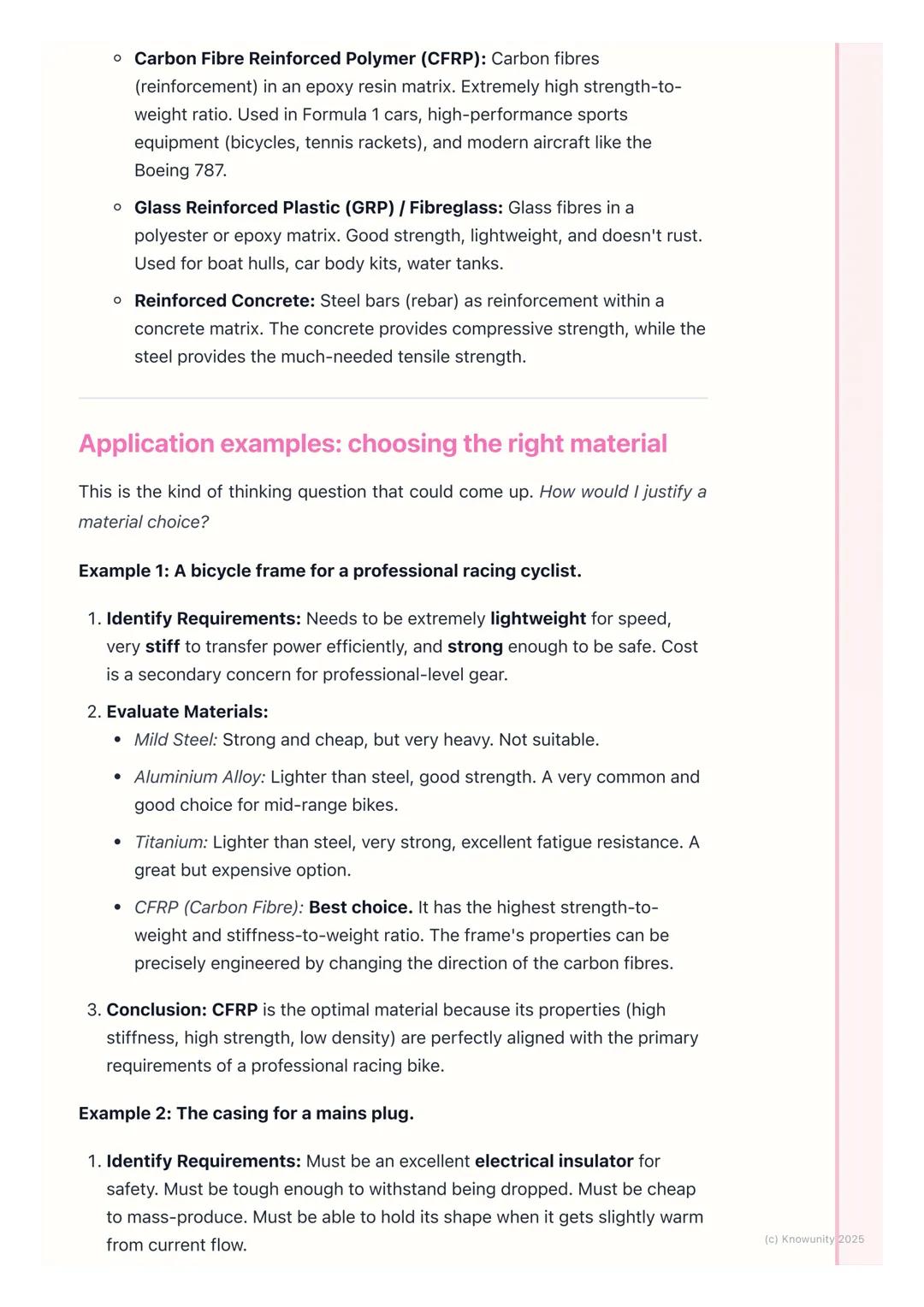
Ceramics are the tough guys of high-temperature applications. They're incredibly hard, excellent insulators, and chemically inert. Glass is an everyday ceramic that's actually amorphous (randomly arranged atoms), while concrete dominates construction as a ceramic composite.
Advanced ceramics like silicon carbide are used for cutting tools because of their extreme hardness. The main downside? They're brittle - ceramics crack rather than bend when overstressed.
Composites are engineered materials designed to be better than the sum of their parts. They have a matrix (the binder) and reinforcement (usually fibres) that work together. The matrix transfers loads to the stronger reinforcement.
Carbon fibre reinforced polymer (CFRP) dominates high-performance applications - Formula 1 cars, racing bikes, modern aircraft. Glass reinforced plastic (fibreglass) offers good strength at lower cost for boat hulls and car panels.
Design Principle: Composites let engineers put strength exactly where it's needed by controlling fibre direction and density.
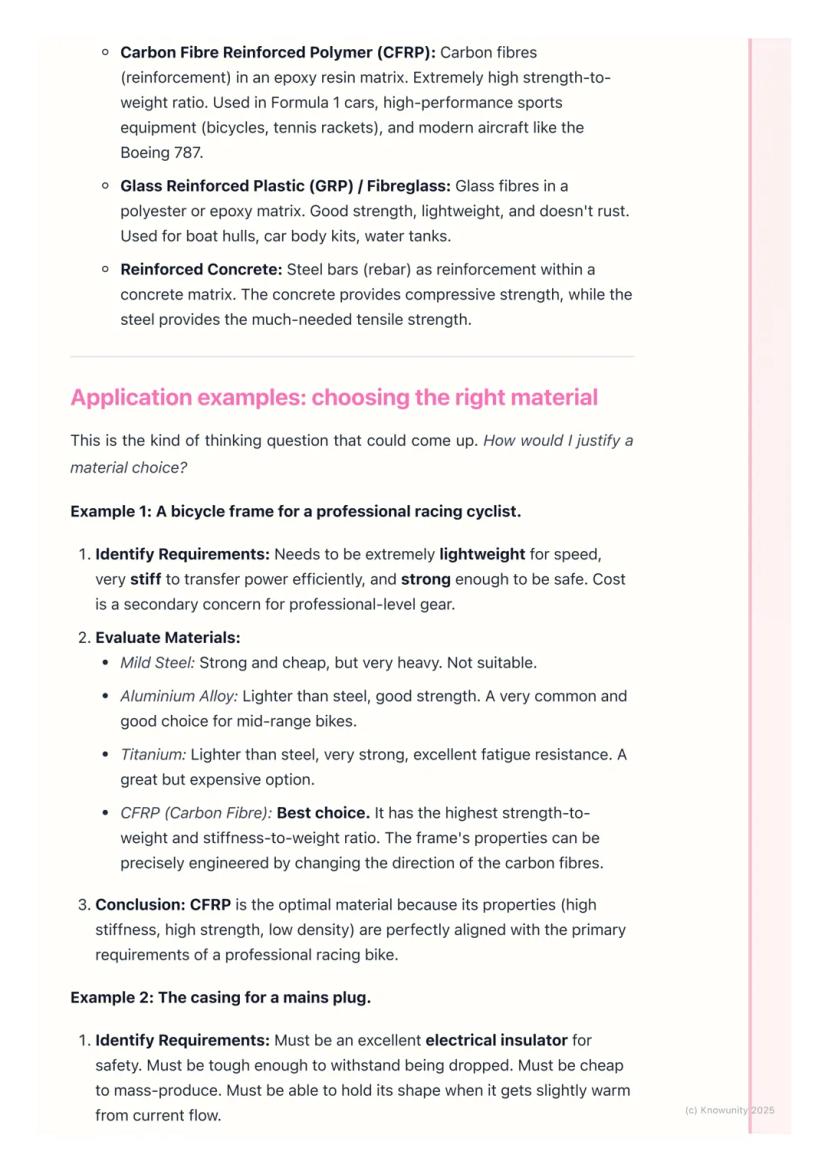
Choosing the right material means matching properties to requirements. For a professional racing bike, you need maximum stiffness and minimum weight. CFRP wins because its strength-to-weight ratio is unbeatable, and properties can be tailored by controlling fibre orientation.
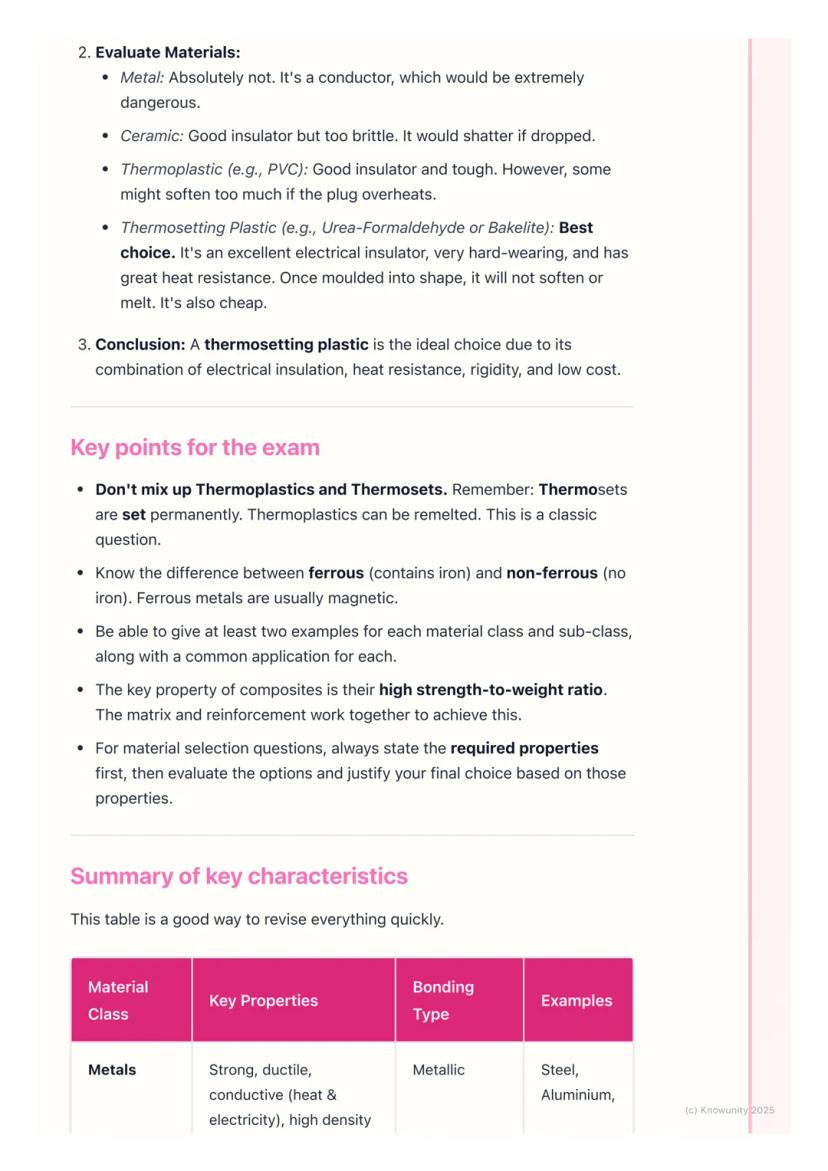
For a mains plug casing, safety trumps everything else. It must be an electrical insulator, tough enough to survive being dropped, and heat-resistant. Thermosetting plastics like Bakelite are perfect - excellent insulators that won't soften if the plug overheats.
Material selection process always follows the same pattern: identify requirements, evaluate options against those requirements, then justify your choice. Cost, availability, and manufacturing methods also influence real-world decisions.
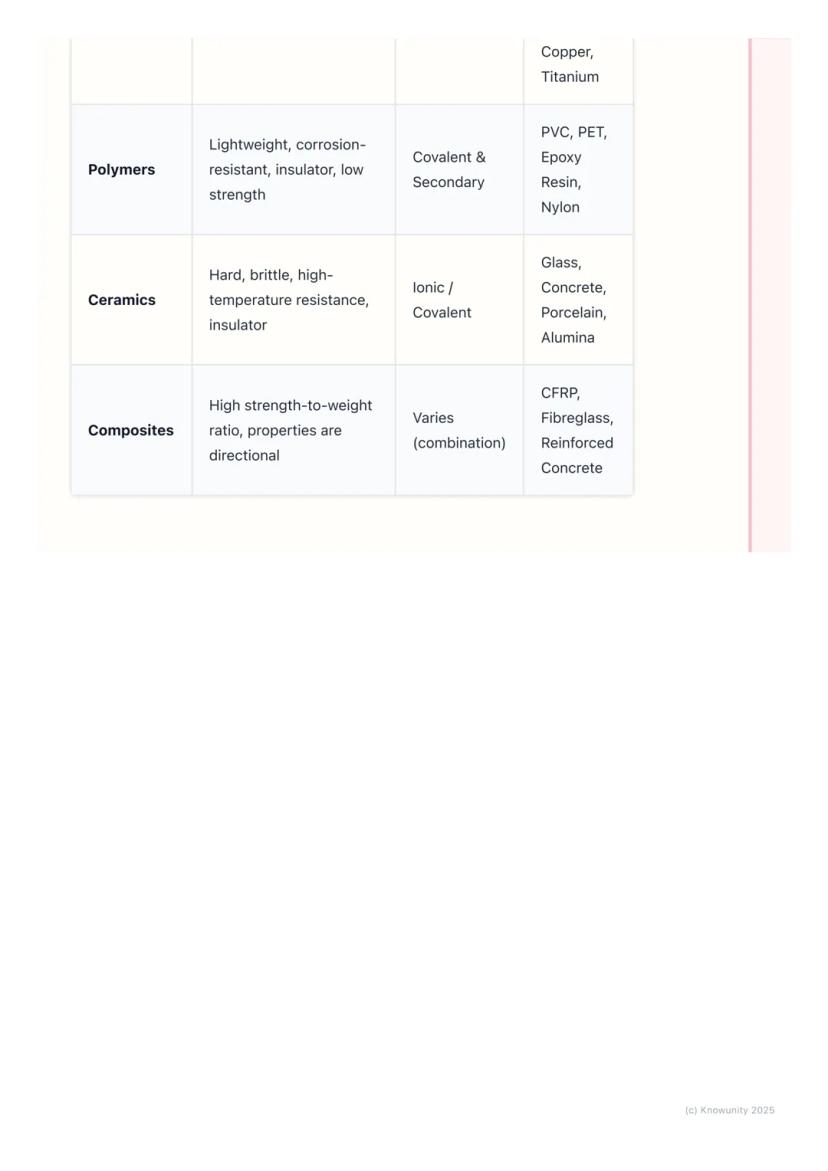
Don't forget the key characteristics - metals conduct and are ductile, polymers are lightweight insulators, ceramics are hard but brittle, and composites offer engineered properties. Each family has its sweet spot.
Success Strategy: For exam questions, always state the required properties first, then systematically evaluate each material option before making your justified recommendation.
Nuestro compañero de IA está específicamente adaptado a las necesidades de los estudiantes. Basándonos en los millones de contenidos que tenemos en la plataforma, podemos dar a los estudiantes respuestas realmente significativas y relevantes. Pero no se trata solo de respuestas, el compañero también guía a los estudiantes a través de sus retos de aprendizaje diarios, con planes de aprendizaje personalizados, cuestionarios o contenidos en el chat y una personalización del 100% basada en las habilidades y el desarrollo de los estudiantes.
Puedes descargar la app en Google Play Store y Apple App Store.
¡Sí lo es! Tienes acceso totalmente gratuito a todo el contenido de la app, puedes chatear con otros alumnos y recibir ayuda inmeditamente. Puedes ganar dinero utilizando la aplicación, que te permitirá acceder a determinadas funciones.
App Store
Google Play
La app es muy fácil de usar y está muy bien diseñada. Hasta ahora he encontrado todo lo que estaba buscando y he podido aprender mucho de las presentaciones. Definitivamente utilizaré la aplicación para un examen de clase. Y, por supuesto, también me sirve mucho de inspiración.
Pablo
usuario de iOS
Esta app es realmente genial. Hay tantos apuntes de clase y ayuda [...]. Tengo problemas con matemáticas, por ejemplo, y la aplicación tiene muchas opciones de ayuda. Gracias a Knowunity, he mejorado en mates. Se la recomiendo a todo el mundo.
Elena
usuaria de Android
Vaya, estoy realmente sorprendida. Acabo de probar la app porque la he visto anunciada muchas veces y me he quedado absolutamente alucinada. Esta app es LA AYUDA que quieres para el insti y, sobre todo, ofrece muchísimas cosas, como ejercicios y hojas informativas, que a mí personalmente me han sido MUY útiles.
Ana
usuaria de iOS
Solía tener dificultades para completar mis tareas a tiempo hasta que descubrí Knowunity, que no solo facilita subir mi propio contenido sino que también proporciona excelentes resúmenes que hacen mi trabajo más rápido y eficiente.
Thomas R
usuario de iOS
Siempre era un desafío encontrar toda la información importante para mis tareas – desde que comencé a usar Knowunity, puedo simplemente subir mi contenido y beneficiarme de los resúmenes de otros, lo que me ayuda mucho con la organización.
Lisa M
usuario de Android
A menudo sentía que no tenía suficiente visión general al estudiar, pero desde que comencé a usar Knowunity, eso ya no es un problema – subo mi contenido y siempre encuentro resúmenes útiles en la plataforma, lo que hace mi aprendizaje mucho más fácil.
David K
usuario de iOS
¡La app es buenísima! Sólo tengo que introducir el tema en la barra de búsqueda y recibo la respuesta muy rápido. No tengo que ver 10 vídeos de YouTube para entender algo, así que me ahorro tiempo. ¡Muy recomendable!
Sara
usuaria de Android
En el instituto era muy malo en matemáticas, pero gracias a la app, ahora saco mejores notas. Os agradezco mucho que hayáis creado la aplicación.
Roberto
usuario de Android
Solía ser muy difícil reunir toda la información para mis presentaciones. Pero desde que comencé a usar Knowunity, solo subo mis notas y encuentro increíbles resúmenes de otros – ¡hace mi estudio mucho más eficiente!
Julia S
usuario de Android
Siempre estaba estresado con todo el material de estudio, pero desde que comencé a usar Knowunity, subo mis cosas y reviso los geniales resúmenes de otros – realmente me ayuda a manejar todo mejor y es mucho menos estresante.
Marco B
usuario de iOS
LOS QUIZZES Y FLASHCARDS SON SÚPER ÚTILES Y AMO Knowunity AI. TAMBIÉN ES LITERALMENTE COMO CHATGPT PERO MÁS INTELIGENTE!! ME AYUDÓ CON MIS PROBLEMAS DE RÍMEL TAMBIÉN!! Y CON MIS MATERIAS REALES OBVIO! 😍😁😲🤑💗✨🎀😮
Sarah L
usuario de Android
Antes pasaba horas buscando en Google materiales escolares, pero ahora solo subo mis cosas a Knowunity y reviso los útiles resúmenes de otros – me siento mucho más seguro cuando me preparo para los exámenes.
Paul T
usuario de iOS
La app es muy fácil de usar y está muy bien diseñada. Hasta ahora he encontrado todo lo que estaba buscando y he podido aprender mucho de las presentaciones. Definitivamente utilizaré la aplicación para un examen de clase. Y, por supuesto, también me sirve mucho de inspiración.
Pablo
usuario de iOS
Esta app es realmente genial. Hay tantos apuntes de clase y ayuda [...]. Tengo problemas con matemáticas, por ejemplo, y la aplicación tiene muchas opciones de ayuda. Gracias a Knowunity, he mejorado en mates. Se la recomiendo a todo el mundo.
Elena
usuaria de Android
Vaya, estoy realmente sorprendida. Acabo de probar la app porque la he visto anunciada muchas veces y me he quedado absolutamente alucinada. Esta app es LA AYUDA que quieres para el insti y, sobre todo, ofrece muchísimas cosas, como ejercicios y hojas informativas, que a mí personalmente me han sido MUY útiles.
Ana
usuaria de iOS
Solía tener dificultades para completar mis tareas a tiempo hasta que descubrí Knowunity, que no solo facilita subir mi propio contenido sino que también proporciona excelentes resúmenes que hacen mi trabajo más rápido y eficiente.
Thomas R
usuario de iOS
Siempre era un desafío encontrar toda la información importante para mis tareas – desde que comencé a usar Knowunity, puedo simplemente subir mi contenido y beneficiarme de los resúmenes de otros, lo que me ayuda mucho con la organización.
Lisa M
usuario de Android
A menudo sentía que no tenía suficiente visión general al estudiar, pero desde que comencé a usar Knowunity, eso ya no es un problema – subo mi contenido y siempre encuentro resúmenes útiles en la plataforma, lo que hace mi aprendizaje mucho más fácil.
David K
usuario de iOS
¡La app es buenísima! Sólo tengo que introducir el tema en la barra de búsqueda y recibo la respuesta muy rápido. No tengo que ver 10 vídeos de YouTube para entender algo, así que me ahorro tiempo. ¡Muy recomendable!
Sara
usuaria de Android
En el instituto era muy malo en matemáticas, pero gracias a la app, ahora saco mejores notas. Os agradezco mucho que hayáis creado la aplicación.
Roberto
usuario de Android
Solía ser muy difícil reunir toda la información para mis presentaciones. Pero desde que comencé a usar Knowunity, solo subo mis notas y encuentro increíbles resúmenes de otros – ¡hace mi estudio mucho más eficiente!
Julia S
usuario de Android
Siempre estaba estresado con todo el material de estudio, pero desde que comencé a usar Knowunity, subo mis cosas y reviso los geniales resúmenes de otros – realmente me ayuda a manejar todo mejor y es mucho menos estresante.
Marco B
usuario de iOS
LOS QUIZZES Y FLASHCARDS SON SÚPER ÚTILES Y AMO Knowunity AI. TAMBIÉN ES LITERALMENTE COMO CHATGPT PERO MÁS INTELIGENTE!! ME AYUDÓ CON MIS PROBLEMAS DE RÍMEL TAMBIÉN!! Y CON MIS MATERIAS REALES OBVIO! 😍😁😲🤑💗✨🎀😮
Sarah L
usuario de Android
Antes pasaba horas buscando en Google materiales escolares, pero ahora solo subo mis cosas a Knowunity y reviso los útiles resúmenes de otros – me siento mucho más seguro cuando me preparo para los exámenes.
Paul T
usuario de iOS
Ever wondered why your phone case is plastic but your bike frame might be carbon fibre? Material classification is all about understanding the four main families of engineering materials and choosing the right one for each job. This knowledge is... Mostrar más
Acceso a todos los documentos
Mejora tus notas
Únete a millones de estudiantes
Understanding material classification starts with recognising that all engineering materials fall into four main families based on their atomic structure. This isn't just theory - it's the foundation that helps engineers make smart choices every day.
The four core material families are metals, polymers, ceramics, and composites. Each family has unique properties that make them perfect for different applications. Think of it like choosing the right tool for a job - you wouldn't use a hammer to cut wood!
Classification systems group materials by their atomic bonding and structure. This makes it easier to predict how they'll behave under stress, heat, or in different environments.
Quick Tip: Remember that material choice always comes down to matching properties with requirements - strength, cost, weight, and durability are the big four factors to consider.
Acceso a todos los documentos
Mejora tus notas
Únete a millones de estudiantes
Metals are your go-to materials when you need strength and conductivity. They have metallic bonds between atoms, creating that characteristic ability to conduct heat and electricity. Most of the structural materials around you are metals.
Polymers (plastics) are large molecules made from repeating units called monomers. They're lightweight, corrosion-resistant, and brilliant insulators. The variety of plastics available today is incredible - from soft bin bags to tough car bumpers.
Ceramics are hard, brittle materials held together by strong ionic or covalent bonds. They're fantastic insulators and can handle extreme temperatures, but they'll crack rather than bend under stress.
Composites combine two or more different materials to create something better than either component alone. It's like making a super-material by mixing the best properties of different families together.
Key Insight: Each material family has trade-offs - metals are strong but heavy, polymers are light but weaker, ceramics are hard but brittle, and composites can be engineered for specific needs.
Acceso a todos los documentos
Mejora tus notas
Únete a millones de estudiantes
Ferrous metals contain iron as their main ingredient, making them magnetic and generally strong. Mild steel is everywhere - car bodies, structural beams, nuts and bolts. It's cheap and strong but rusts easily unless protected.
Stainless steel adds chromium to create a protective oxide layer that resists corrosion. That's why your kitchen sink doesn't rust! Cast iron has high carbon content, making it hard but brittle - perfect for engine blocks where you need compression strength.
Non-ferrous metals don't contain iron, so they're not magnetic and often resist corrosion better. Aluminium is brilliant for aircraft because it's light yet strong. Copper dominates electrical wiring because it conducts electricity so well.
Titanium is the superstar of metals - incredibly strong for its weight and virtually corrosion-proof. It's expensive, but when you need the best (like in aircraft or medical implants), titanium delivers.
Memory Trick: Ferrous = iron = magnetic. If a magnet sticks to it, it's probably ferrous!
Acceso a todos los documentos
Mejora tus notas
Únete a millones de estudiantes
Thermoplastics can be melted and reshaped repeatedly - think of them as the recyclable plastics. Heat them up, they soften; cool them down, they harden. PVC pipes, PET drink bottles, and nylon gears all fall into this category.
The polymer chains in thermoplastics are held by weak forces that break easily when heated. This reversible process is why you can recycle these plastics into new products.
Thermosetting plastics undergo a permanent chemical change when heated - once they're set, that's it. Overheat them and they'll char and decompose rather than melt. Epoxy resin creates incredibly strong adhesives, while Bakelite handles heat brilliantly.
The difference comes down to bonding - thermosets form strong cross-links between polymer chains that can't be broken by reheating. This makes them perfect for applications requiring heat resistance.
Exam Alert: This thermoplastic vs thermoset distinction is a classic exam question. Remember: thermoplastics melt repeatedly, thermosets set permanently.
Acceso a todos los documentos
Mejora tus notas
Únete a millones de estudiantes
Ceramics are the tough guys of high-temperature applications. They're incredibly hard, excellent insulators, and chemically inert. Glass is an everyday ceramic that's actually amorphous (randomly arranged atoms), while concrete dominates construction as a ceramic composite.
Advanced ceramics like silicon carbide are used for cutting tools because of their extreme hardness. The main downside? They're brittle - ceramics crack rather than bend when overstressed.
Composites are engineered materials designed to be better than the sum of their parts. They have a matrix (the binder) and reinforcement (usually fibres) that work together. The matrix transfers loads to the stronger reinforcement.
Carbon fibre reinforced polymer (CFRP) dominates high-performance applications - Formula 1 cars, racing bikes, modern aircraft. Glass reinforced plastic (fibreglass) offers good strength at lower cost for boat hulls and car panels.
Design Principle: Composites let engineers put strength exactly where it's needed by controlling fibre direction and density.
Acceso a todos los documentos
Mejora tus notas
Únete a millones de estudiantes
Choosing the right material means matching properties to requirements. For a professional racing bike, you need maximum stiffness and minimum weight. CFRP wins because its strength-to-weight ratio is unbeatable, and properties can be tailored by controlling fibre orientation.
For a mains plug casing, safety trumps everything else. It must be an electrical insulator, tough enough to survive being dropped, and heat-resistant. Thermosetting plastics like Bakelite are perfect - excellent insulators that won't soften if the plug overheats.
Material selection process always follows the same pattern: identify requirements, evaluate options against those requirements, then justify your choice. Cost, availability, and manufacturing methods also influence real-world decisions.
Don't forget the key characteristics - metals conduct and are ductile, polymers are lightweight insulators, ceramics are hard but brittle, and composites offer engineered properties. Each family has its sweet spot.
Success Strategy: For exam questions, always state the required properties first, then systematically evaluate each material option before making your justified recommendation.
Acceso a todos los documentos
Mejora tus notas
Únete a millones de estudiantes
Nuestro compañero de IA está específicamente adaptado a las necesidades de los estudiantes. Basándonos en los millones de contenidos que tenemos en la plataforma, podemos dar a los estudiantes respuestas realmente significativas y relevantes. Pero no se trata solo de respuestas, el compañero también guía a los estudiantes a través de sus retos de aprendizaje diarios, con planes de aprendizaje personalizados, cuestionarios o contenidos en el chat y una personalización del 100% basada en las habilidades y el desarrollo de los estudiantes.
Puedes descargar la app en Google Play Store y Apple App Store.
¡Sí lo es! Tienes acceso totalmente gratuito a todo el contenido de la app, puedes chatear con otros alumnos y recibir ayuda inmeditamente. Puedes ganar dinero utilizando la aplicación, que te permitirá acceder a determinadas funciones.
0
Herramientas Inteligentes NUEVO
Convierte estos apuntes en: ✓ 50+ Preguntas de Práctica ✓ Tarjetas de Estudio Interactivas ✓ Examen Completo de Práctica ✓ Esquemas de Ensayo
App Store
Google Play
La app es muy fácil de usar y está muy bien diseñada. Hasta ahora he encontrado todo lo que estaba buscando y he podido aprender mucho de las presentaciones. Definitivamente utilizaré la aplicación para un examen de clase. Y, por supuesto, también me sirve mucho de inspiración.
Pablo
usuario de iOS
Esta app es realmente genial. Hay tantos apuntes de clase y ayuda [...]. Tengo problemas con matemáticas, por ejemplo, y la aplicación tiene muchas opciones de ayuda. Gracias a Knowunity, he mejorado en mates. Se la recomiendo a todo el mundo.
Elena
usuaria de Android
Vaya, estoy realmente sorprendida. Acabo de probar la app porque la he visto anunciada muchas veces y me he quedado absolutamente alucinada. Esta app es LA AYUDA que quieres para el insti y, sobre todo, ofrece muchísimas cosas, como ejercicios y hojas informativas, que a mí personalmente me han sido MUY útiles.
Ana
usuaria de iOS
Solía tener dificultades para completar mis tareas a tiempo hasta que descubrí Knowunity, que no solo facilita subir mi propio contenido sino que también proporciona excelentes resúmenes que hacen mi trabajo más rápido y eficiente.
Thomas R
usuario de iOS
Siempre era un desafío encontrar toda la información importante para mis tareas – desde que comencé a usar Knowunity, puedo simplemente subir mi contenido y beneficiarme de los resúmenes de otros, lo que me ayuda mucho con la organización.
Lisa M
usuario de Android
A menudo sentía que no tenía suficiente visión general al estudiar, pero desde que comencé a usar Knowunity, eso ya no es un problema – subo mi contenido y siempre encuentro resúmenes útiles en la plataforma, lo que hace mi aprendizaje mucho más fácil.
David K
usuario de iOS
¡La app es buenísima! Sólo tengo que introducir el tema en la barra de búsqueda y recibo la respuesta muy rápido. No tengo que ver 10 vídeos de YouTube para entender algo, así que me ahorro tiempo. ¡Muy recomendable!
Sara
usuaria de Android
En el instituto era muy malo en matemáticas, pero gracias a la app, ahora saco mejores notas. Os agradezco mucho que hayáis creado la aplicación.
Roberto
usuario de Android
Solía ser muy difícil reunir toda la información para mis presentaciones. Pero desde que comencé a usar Knowunity, solo subo mis notas y encuentro increíbles resúmenes de otros – ¡hace mi estudio mucho más eficiente!
Julia S
usuario de Android
Siempre estaba estresado con todo el material de estudio, pero desde que comencé a usar Knowunity, subo mis cosas y reviso los geniales resúmenes de otros – realmente me ayuda a manejar todo mejor y es mucho menos estresante.
Marco B
usuario de iOS
LOS QUIZZES Y FLASHCARDS SON SÚPER ÚTILES Y AMO Knowunity AI. TAMBIÉN ES LITERALMENTE COMO CHATGPT PERO MÁS INTELIGENTE!! ME AYUDÓ CON MIS PROBLEMAS DE RÍMEL TAMBIÉN!! Y CON MIS MATERIAS REALES OBVIO! 😍😁😲🤑💗✨🎀😮
Sarah L
usuario de Android
Antes pasaba horas buscando en Google materiales escolares, pero ahora solo subo mis cosas a Knowunity y reviso los útiles resúmenes de otros – me siento mucho más seguro cuando me preparo para los exámenes.
Paul T
usuario de iOS
La app es muy fácil de usar y está muy bien diseñada. Hasta ahora he encontrado todo lo que estaba buscando y he podido aprender mucho de las presentaciones. Definitivamente utilizaré la aplicación para un examen de clase. Y, por supuesto, también me sirve mucho de inspiración.
Pablo
usuario de iOS
Esta app es realmente genial. Hay tantos apuntes de clase y ayuda [...]. Tengo problemas con matemáticas, por ejemplo, y la aplicación tiene muchas opciones de ayuda. Gracias a Knowunity, he mejorado en mates. Se la recomiendo a todo el mundo.
Elena
usuaria de Android
Vaya, estoy realmente sorprendida. Acabo de probar la app porque la he visto anunciada muchas veces y me he quedado absolutamente alucinada. Esta app es LA AYUDA que quieres para el insti y, sobre todo, ofrece muchísimas cosas, como ejercicios y hojas informativas, que a mí personalmente me han sido MUY útiles.
Ana
usuaria de iOS
Solía tener dificultades para completar mis tareas a tiempo hasta que descubrí Knowunity, que no solo facilita subir mi propio contenido sino que también proporciona excelentes resúmenes que hacen mi trabajo más rápido y eficiente.
Thomas R
usuario de iOS
Siempre era un desafío encontrar toda la información importante para mis tareas – desde que comencé a usar Knowunity, puedo simplemente subir mi contenido y beneficiarme de los resúmenes de otros, lo que me ayuda mucho con la organización.
Lisa M
usuario de Android
A menudo sentía que no tenía suficiente visión general al estudiar, pero desde que comencé a usar Knowunity, eso ya no es un problema – subo mi contenido y siempre encuentro resúmenes útiles en la plataforma, lo que hace mi aprendizaje mucho más fácil.
David K
usuario de iOS
¡La app es buenísima! Sólo tengo que introducir el tema en la barra de búsqueda y recibo la respuesta muy rápido. No tengo que ver 10 vídeos de YouTube para entender algo, así que me ahorro tiempo. ¡Muy recomendable!
Sara
usuaria de Android
En el instituto era muy malo en matemáticas, pero gracias a la app, ahora saco mejores notas. Os agradezco mucho que hayáis creado la aplicación.
Roberto
usuario de Android
Solía ser muy difícil reunir toda la información para mis presentaciones. Pero desde que comencé a usar Knowunity, solo subo mis notas y encuentro increíbles resúmenes de otros – ¡hace mi estudio mucho más eficiente!
Julia S
usuario de Android
Siempre estaba estresado con todo el material de estudio, pero desde que comencé a usar Knowunity, subo mis cosas y reviso los geniales resúmenes de otros – realmente me ayuda a manejar todo mejor y es mucho menos estresante.
Marco B
usuario de iOS
LOS QUIZZES Y FLASHCARDS SON SÚPER ÚTILES Y AMO Knowunity AI. TAMBIÉN ES LITERALMENTE COMO CHATGPT PERO MÁS INTELIGENTE!! ME AYUDÓ CON MIS PROBLEMAS DE RÍMEL TAMBIÉN!! Y CON MIS MATERIAS REALES OBVIO! 😍😁😲🤑💗✨🎀😮
Sarah L
usuario de Android
Antes pasaba horas buscando en Google materiales escolares, pero ahora solo subo mis cosas a Knowunity y reviso los útiles resúmenes de otros – me siento mucho más seguro cuando me preparo para los exámenes.
Paul T
usuario de iOS